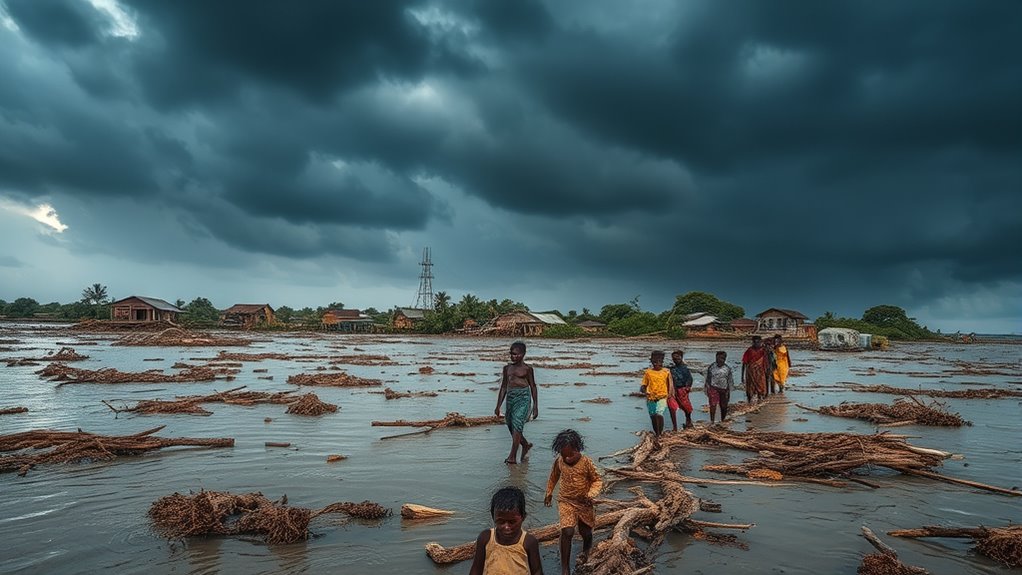

Climate migration is rising rapidly as extreme weather, rising sea levels, and droughts push people to relocate. This shift can strain local economies, overwhelm infrastructure, and increase tensions in host communities, but it also offers opportunities for cultural diversity and economic renewal. Governments and organizations are developing policies to better manage these changes and support vulnerable populations. To understand how these shifts will impact societies and possible solutions, keep exploring further insights on this essential topic.

Get travel and outdoor gear delivered free with Prime
- Fast, free delivery on millions of items
- Prime Video, Amazon Music and more included
- Member-only deals all year
Key Takeaways
- Climate-induced events like floods and droughts drive both rapid and slow migration, impacting local populations.
- Migration strains host communities’ resources, infrastructure, and social cohesion, potentially causing tensions and inequality.
- Climate migrants can bring skills and diversity, offering opportunities for economic revitalization in receiving areas.
- Effective policy responses require international cooperation, data sharing, and inclusive strategies to manage socioeconomic impacts.
- Adaptation strategies, including resilient infrastructure and flexible policies, are essential for long-term climate migration management.
Products Worth Considering

DJI Osmo Action 4 Standard Combo Waterproof Action Camera

Samsonite Freeform 2-Piece Hardside Luggage Set, Carry-On and Large Checked Suitcase, Black

DJI Osmo Mobile 8 3-Axis Smartphone Gimbal Stabilizer
As an affiliate, we earn on qualifying purchases.
Understanding the Drivers Behind Climate-Related Displacement

Understanding the drivers behind climate-related displacement is essential because these factors directly influence who moves, where they go, and how communities can prepare. You need to recognize that extreme weather events like floods, storms, and droughts are primary triggers, forcing people to leave their homes quickly. Rising sea levels threaten coastal areas with permanent displacement, pushing populations inland or across borders. Desertification and water shortages in regions like the Sahel make farming impossible, driving slow-onset migration. Climate change acts as a risk multiplier, worsening environmental degradation, food insecurity, and disease spread. These interconnected factors shape migration patterns, often disproportionately affecting vulnerable groups. Additionally, the mechanisms of displacement are complex and vary depending on local socio-economic conditions, which can influence the resilience and adaptation strategies of affected populations. By understanding these drivers, you can better anticipate migration trends and develop targeted strategies to reduce displacement risks and support affected communities.
The Socioeconomic Ripple Effects of Climate Migration

Climate migration triggers a complex web of socioeconomic ripple effects that extend beyond individual displacement. You might see local economies destabilize as resources become strained and labor markets shift. Communities could face increased competition for jobs, housing, and social services, leading to tensions or inequality. In host regions, infrastructure may strain under the influx of newcomers, impacting healthcare, education, and public services. You may also notice changes in social cohesion, with integration challenges affecting community stability. Additionally, migration can reshape urban landscapes, prompting rapid development or overcrowding. These effects often ripple outward, influencing regional economies, governance, and social structures. Addressing these impacts requires coordinated strategies that support resilience, equitable resource distribution, and social cohesion to minimize disruption and foster sustainable growth amidst climate-induced movement. Understanding cookie categories can help policymakers develop targeted solutions to support affected communities effectively.
Challenges and Opportunities for Host Communities

Host communities often face significant challenges when climate migrants arrive, as they must quickly adapt to increased demand for housing, healthcare, and social services. You might see crowded neighborhoods with overcrowded shelters, strained hospitals handling more patients, and social programs stretched thin. Infrastructure can become overwhelmed, leading to housing shortages and increased competition for resources. Community tensions may rise as locals and newcomers navigate cultural differences and economic competition. Additionally, the influx of new residents can influence local demographics and dog names trends, reflecting the evolving cultural landscape. However, with these challenges come opportunities for growth and renewal. Migrants can bring new skills, cultural diversity, and entrepreneurial energy, revitalizing local economies. Investing in resilient infrastructure and inclusive policies helps communities turn these pressures into positive change, fostering stronger, more adaptable environments for everyone involved.
Policy Responses and the Role of Global Cooperation

Effective policy responses are essential to managing the complex challenges posed by climate migration, and their success depends heavily on robust international cooperation. You need coordinated efforts to develop inclusive migration policies, ensuring migrants’ rights and access to services. Sharing data, best practices, and resources across borders can enhance preparedness and resilience. International agreements, like the UN’s Climate Change Conferences, can foster commitments to support vulnerable populations and allocate funding for adaptation strategies. You must also prioritize climate-resilient infrastructure and health systems, especially in high-risk regions. Strengthening cooperation among governments, NGOs, and international organizations ensures thorough responses that address socioeconomic impacts and reduce vulnerabilities. Recognizing the importance of accurate data collection can significantly improve targeted interventions and resource distribution. Only through unified global action can you effectively manage climate migration’s increasing scale and complexities.

As the impacts of climate migration become more pronounced, planning for long-term adaptation is essential to mitigate future risks. You need to focus on resilient infrastructure, sustainable urban planning, and inclusive policies that support vulnerable populations. Imagine communities fortified against floods, cities designed to absorb climate shocks, and social systems that integrate migrants seamlessly. Developing flexible policies that evolve with changing climate patterns will be critical. You should also invest in education and capacity-building to empower communities to adapt proactively. By prioritizing these strategies, you can help reduce displacement, protect livelihoods, and foster resilience. Ultimately, a proactive approach ensures communities not only survive but thrive amid long-term climate challenges. Incorporating climate-resilient infrastructure will further strengthen communities’ ability to withstand environmental stresses.
Frequently Asked Questions
How Do Climate Migrants Access Healthcare in New Regions?
You might struggle to access healthcare in new regions if systems aren’t inclusive or well-equipped. As a climate migrant, you’ll often face barriers like language differences, lack of documentation, or limited resources. You should seek out migrant-friendly health services, community clinics, or international aid programs. Advocating for policies that improve healthcare access and integration helps make sure you receive the care you need without undue hardship.
What Mental Health Support Is Available for Climate-Displaced Populations?
You can access mental health support through targeted programs by local governments, NGOs, and international agencies. Many offer counseling, peer support groups, and mobile mental health services tailored to climate-displaced populations. Some regions incorporate psychosocial care into emergency response plans, focusing on trauma and stress management. However, access varies widely, and advocating for more inclusive, culturally sensitive mental health services is vital to address the unique needs of climate migrants.
How Can Urban Planning Accommodate Increasing Climate Migrants?
You can start by designing flexible, resilient infrastructure that adapts to population growth and climate challenges. Incorporate green spaces, affordable housing, and accessible transportation to support newcomers. Engage communities in planning to guarantee their needs are met. Prioritize sustainable urban development and invest in climate-resilient buildings. By integrating these strategies, you create inclusive cities that can effectively accommodate climate migrants while promoting social cohesion and environmental sustainability.
What Legal Protections Exist for Cross-Border Climate Migrants?
Currently, legal protections for cross-border climate migrants are limited. You should know that international law doesn’t specifically recognize climate migrants as refugees, so they lack formal protections under the 1951 Refugee Convention. Some regional agreements, like the Cartagena Convention in the Caribbean, offer limited support. You can advocate for stronger policies, but real protections depend on national laws and international cooperation, which are still developing.
How Do Climate Migration Patterns Affect Global Economic Stability?
Climate migration patterns are like ripples spreading across the global economy, causing shifts that can destabilize markets and strain resources. As more people move, local economies face disruptions, and international trade can suffer from unpredictable labor supplies and consumer demand. You might see increased poverty, inequality, and social tensions that threaten overall stability. Addressing these patterns requires coordinated efforts to build resilient economies that can adapt to these changing migration flows.
Conclusion
As climate migration continues to unfold, it’s a tide you can’t ignore—shaping societies like a master sculptor shaping clay. Your awareness and action are vital in steering this complex wave toward resilience. By understanding its roots and impacts, you become part of the solution, helping communities adapt and thrive amid change. Together, we can turn this rising tide into an opportunity for renewal, ensuring a future where hope flows as abundantly as the challenges we face.