
The UN plays a key role in resolving conflicts by deploying peacekeeping missions, promoting international norms, and facilitating negotiations. Successes like stabilizing Liberia and fostering peace in various regions show its positive impact. However, failures in places like Darfur reveal limitations due to resource constraints, complex local politics, and geopolitical rivalries. If you want to understand how these efforts shape global peace and where challenges still remain, there’s more to discover below.
Listen free for 30 days with Audible
Thousands of audiobooks and originals — cancel anytime.
As an affiliate, we earn on qualifying purchases.
Key Takeaways
- The UN promotes peace through peacekeeping missions, mediations, and setting international norms and standards.
- Successes include stabilizing Liberia with UNMIL and monitoring ceasefires in the Arab-Israeli conflicts.
- Failures often occur due to limited resources, complex local politics, and lack of enforcement capabilities.
- Geopolitical rivalries and veto powers hinder effective intervention and peace enforcement efforts.
- Future challenges involve adapting strategies to emerging threats like terrorism, cyberwarfare, and climate-related conflicts.
Mission Failure: America and the World in the Post-Cold War Era
As an affiliate, we earn on qualifying purchases.
As an affiliate, we earn on qualifying purchases.
Foundations and Purpose of UN Conflict Resolution
Have you ever wondered why the United Nations was created? Its primary purpose is to promote peace and security among nations, aiming to prevent wars before they happen. You see, the UN was established after World War II to foster international cooperation and reduce conflicts. It acts as a platform where countries can mediate disputes, set global norms, and work together on peacekeeping missions. The organization’s foundation is built on principles like respecting sovereignty, promoting human rights, and upholding international law. By doing so, the UN seeks to create a safer world where disputes are resolved peacefully. Its core mission is to prevent violence, support reconciliation, and build lasting peace through collective efforts. Additionally, the effectiveness of its initiatives often depends on the role of conflict resolution strategies employed by member states and peacekeepers.
Landmark Peacekeeping Missions and Their Outcomes
You can see how UN peacekeeping missions have shaped global conflict resolution, starting with UNTSO’s efforts in the Middle East. Success stories like Liberia show that peacekeepers can foster stability, but challenges like Darfur reveal the limits of intervention. These missions highlight both the potential and the obstacles in achieving lasting peace through UN efforts. The effectiveness of these missions often depends on self-sufficient planning and adequate resources to address complex conflicts.
UNTSO’s Middle East Role
Why has the United Nations Truce Supervision Organization (UNTSO) played such a pivotal role in the Middle East? Since its establishment in 1948, UNTSO has been the world’s first peacekeeping mission, tasked with monitoring ceasefires and supervising armistice agreements. Its presence helped reduce hostilities during critical moments, such as the Arab-Israeli conflicts. UNTSO provides impartial oversight, helping prevent full-scale wars by reporting violations and facilitating negotiations. While it hasn’t resolved all disputes, its continuous presence has contributed to maintaining a fragile stability in a highly volatile region. By offering a neutral platform, UNTSO fosters dialogue and confidence-building among conflicting parties. Its work exemplifies how peacekeeping can support diplomatic efforts, even amid persistent tensions and unresolved issues.
Successes in Liberia
The UN’s peacekeeping missions in Liberia stand out as landmark efforts that considerably contributed to ending years of civil conflict. When you look at the United Nations Mission in Liberia (UNMIL), you’ll see a successful example of peace enforcement and nation-building. Established in 2003, UNMIL helped disarm combatants, restore stability, and support civilian-led governance. You can observe how its presence fostered trust, paved the way for democratic elections, and promoted reconciliation among conflicting groups. The mission’s all-encompassing approach, including security, humanitarian aid, and political facilitation, played a critical role. As a result, Liberia transitioned from chaos to stability, reducing violence and setting a foundation for long-term peace. UNMIL’s success demonstrated how coordinated peacekeeping can transform conflict-ridden nations into stable, functioning states. Additionally, the mission’s efforts in track development were crucial in maintaining progress and preventing relapse into violence.
Challenges in Darfur
Despite the successes seen in Liberia, peacekeeping efforts in Darfur have faced significant obstacles that hindered their effectiveness. You see, the UN’s mission struggled with limited resources, complex local politics, and deep-rooted mistrust among conflicting parties. The peacekeepers often couldn’t prevent ongoing violence or protect civilians, leaving many feeling abandoned. The mission’s inability to enforce peace agreements meant atrocities continued unchecked. Internal disagreements within the Security Council delayed decisive action. You might feel the frustration of unmet promises and the heartbreak of unresolved suffering.
- Victims of violence left without justice or safety
- Peacekeepers overwhelmed and under-equipped
- Political divisions stalling vitalinterventions
- Continued displacement and loss of innocent lives
- A lingering sense of failure in safeguarding peace
Promoting International Norms and Legal Frameworks
You play a key role in advancing international standards by supporting the UN’s efforts to establish global norms. These standards influence national policies, shaping how countries respond to conflicts and human rights issues. By promoting legal frameworks, you help create a more consistent and effective approach to maintaining peace worldwide. Understanding the importance of sustainable camping practices can also foster a broader appreciation for environmental stewardship, which is vital for maintaining the natural landscapes where many peacekeeping efforts take place.
Establishing Global Standards
Establishing global standards is essential for shaping international behavior and fostering peace. When you support the UN’s efforts, you help create a cohesive framework that guides nations toward cooperation and stability. These standards set moral and legal benchmarks that hold countries accountable and promote justice. They influence national policies, encourage responsible conduct, and deter conflict. You can feel confident knowing that documents like the Universal Declaration of Human Rights and treaties such as the NPT form the backbone of global norms. These standards inspire hope, unite diverse nations, and lay the groundwork for lasting peace. International norms play a crucial role in maintaining global order and preventing disputes from escalating into conflict.
Influencing National Policies
Global standards set by the UN influence how countries develop and implement their national policies. You see, these norms shape laws on human rights, disarmament, and conflict prevention. Nations often adopt these frameworks to align with international expectations, strengthening global stability. To illustrate, consider how the UN’s norms have affected national policies: enabling open dialogue and fostering mutual understanding among diverse populations. | Norm/Framework | Country Adoption | Impact | |—————-|——————|————————| | Universal Declaration of Human Rights | Most UN members | Improved human rights policies | | Non-Proliferation Treaty | Nuclear states | Reduced nuclear proliferation | | Genocide Convention | Signatory countries | Criminalization of genocide | | Sustainable Development Goals | Global adoption | Policies on peace and development
Notable Successes in Preventing and Ending Conflicts

One of the UN’s most notable achievements lies in its success in preventing and ending conflicts through peacekeeping missions and diplomatic efforts. You can see this in the early peacekeeping missions that helped stabilize volatile regions and build trust among parties. The UN’s role in reducing wars and genocides since the Cold War has been significant. Its success stories include mediating conflicts in Lebanon and the Golan Heights, and supporting peace agreements in Namibia and Cambodia. These efforts have saved countless lives and fostered hope for lasting peace. These peacekeeping initiatives often rely on effective coordination with coastal zone management and local communities to ensure sustainable stability.
- Restoring ceasefires and preventing escalation in critical moments
- Facilitating peaceful progressions of power in fragile states
- Supporting post-conflict nation-building and reconciliation
- Promoting regional stability through diplomatic engagement
- Saving millions from violence and human suffering
Challenges in Addressing Genocide and Humanitarian Crises

Addressing genocide and humanitarian crises is incredibly challenging because prevention often relies on early warning and political will, which are frequently lacking. When crises erupt, the UN’s limited intervention powers can hinder effective action, leaving many situations unresolved. After the immediate crisis, rebuilding and ensuring long-term peace remain difficult, often facing political, logistical, and resource obstacles.
Prevention Difficulties
Why do preventing genocide and humanitarian crises remain some of the toughest challenges for the UN? You face obstacles like delayed intelligence, political disagreements, and limited enforcement power that hinder early warnings and swift action. These issues often lead to devastating outcomes before intervention occurs. You may feel frustration when warnings go unheeded or when geopolitical interests block decisive responses. The emotional toll is high when innocent lives are lost due to preventable atrocities.
- Ignorance of early signs that escalate into violence
- Political conflicts that block timely intervention
- Insufficient resources for rapid response
- Lack of cooperation from member states
- The difficulty of balancing sovereignty with intervention needs
Additionally, the coordination of international efforts is frequently hampered by competing national agendas, making cohesive action challenging.
Limited Intervention Power
Despite the UN’s efforts to promote peace, its intervention power often falls short when dealing with genocides and humanitarian crises. You quickly realize that the organization’s authority depends heavily on member states, especially within the Security Council. Veto powers held by permanent members can block decisive action, leaving atrocities unaddressed. You see how political disagreements hinder swift responses, delaying aid and intervention during crises like Rwanda or Syria. The UN lacks enforcement mechanisms to compel states to comply with resolutions, making it difficult to stop mass violence or provide immediate relief. You understand that these structural limitations weaken the UN’s ability to act decisively in urgent situations, often leaving vulnerable populations without the protection or support they desperately need. Furthermore, the absence of timely intervention can result in prolonged suffering and increased casualties.
Post-Crisis Challenges
Post-crisis challenges often emerge long after the immediate violence has ended, making it difficult for the UN to guarantee lasting peace and stability. You face the formidable task of addressing the deep-rooted trauma, rebuilding trust, and restoring basic services in war-torn areas. The scars of genocide and humanitarian crises linger, complicating reconciliation efforts and prolonging suffering. You must navigate complex political interests, often hindered by limited enforcement power. Additionally, you grapple with resource constraints and the risk of renewed violence. Without sustained commitment, peace remains fragile, and cycles of conflict risk repeating. Recognizing phantom tax implications and addressing unresolved issues like justice for atrocities are crucial for long-term peace.
- Victims continue to suffer in silence, their pain unacknowledged.
- Communities remain divided, fueling future violence.
- Aid efforts are hampered by ongoing insecurity.
- Justice for atrocities remains elusive.
- Hope for long-term peace is fragile.
Limitations and Failures in Complex Conflict Zones
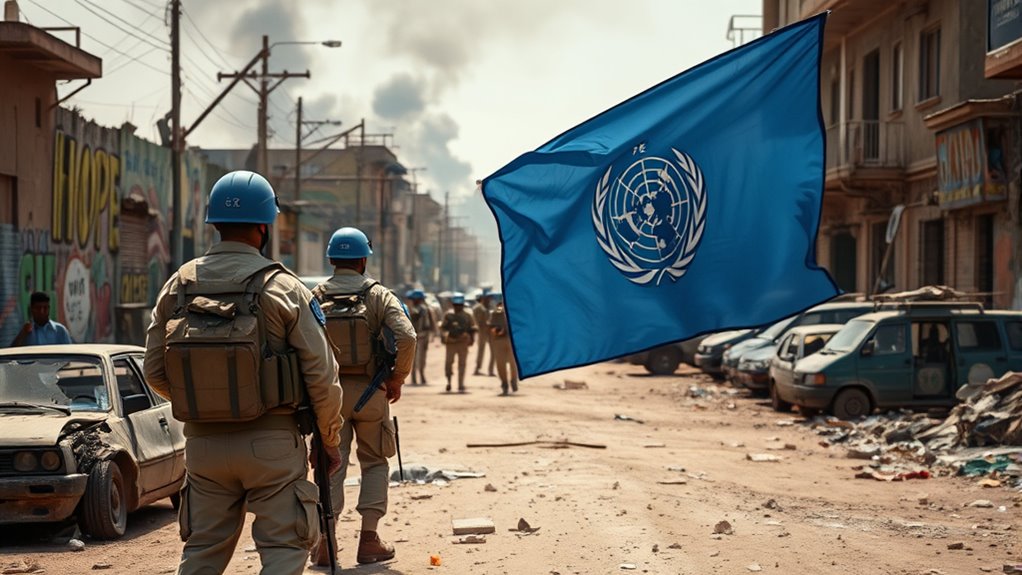
The United Nations often faces significant challenges when attempting to resolve complex conflict zones, where multiple actors and deeply rooted grievances complicate peace efforts. You’ll find that conflicting national interests, regional rivalries, and non-state actors hinder consensus and effective action. The UN’s peacekeeping missions frequently struggle with limited mandates, inadequate resources, and ambiguous objectives, making sustained stability difficult. In places like Syria and Yemen, you see how external influences and local factions undermine peace processes. The UN’s reliance on consensus among Security Council members can delay or block intervention. Additionally, cultural, political, and historical complexities often prevent all-encompassing solutions. These limitations reveal that, despite good intentions, the UN’s capacity to resolve deeply entrenched conflicts remains constrained by geopolitical realities and internal organizational challenges.
The UN’s Role in Shaping Global Relations and Security

The United Nations actively shapes global relations and security by establishing norms, mediating conflicts, and coordinating international responses. You can see its impact through the creation of rules that guide nations, efforts to prevent wars, and facilitating cooperation during crises. The UN fosters a sense of shared responsibility, inspiring hope for peace. It pushes for disarmament and supports diplomatic solutions that save countless lives. Its influence encourages countries to work together instead of alone, shaping a more stable world.
- You feel the power of collective action in moments of crisis
- You witness nations coming together for common goals
- You see hope bloom through diplomatic efforts
- You recognize the importance of international laws
- You believe in the potential for lasting peace
Impact of Geopolitical Dynamics on UN Effectiveness
Global power politics heavily influence how effectively the UN can carry out its conflict resolution efforts. When powerful nations prioritize their interests, it often hampers collective action, leading to stalemates in the Security Council. You’ll notice that geopolitical rivalries, like those between major powers, can block decisive interventions or weaken peacekeeping missions. These nations may also use their influence to sway resolutions or shield allies from accountability. As a result, conflicts may persist or escalate when global interests overshadow international peace efforts. You’ll see that this dynamic undermines the UN’s credibility and hampers its authority to act impartially. To be effective, the UN must navigate these geopolitical tensions, balancing national interests with the collective goal of peace and security.
Evolving Threats and Future Directions for Peace Efforts

As new security threats continue to emerge, the UN must adapt its peacekeeping and conflict resolution strategies to stay effective. You face challenges like terrorism, cyberwarfare, climate-induced conflicts, and asymmetric threats that demand innovative responses. The future of peace efforts relies on your ability to anticipate and address these dangers proactively. To do so, you need to:
Emerging threats demand innovative, proactive UN peacekeeping strategies to ensure global safety and sustainable peace.
- Develop rapid deployment capabilities for emerging crises
- Strengthen regional collaborations for localized solutions
- Integrate technology and intelligence for better conflict prediction
- Foster resilience in vulnerable communities
- Build flexible, context-specific peacekeeping missions
These steps will help you navigate complex threats, protect lives, and lay the groundwork for sustainable peace amid a rapidly changing global landscape.
Strengthening the UN’s Capacity for Effective Intervention
To effectively intervene in conflicts and prevent escalation, the UN must enhance its rapid deployment capabilities and operational flexibility. You need to streamline decision-making processes within the Security Council and establish standby teams ready to deploy immediately. Investing in specialized peacekeeping units, equipped with modern technology and trained personnel, will improve responsiveness. Collaboration with regional organizations and local actors is essential to tailor interventions effectively. Additionally, flexible mandates that adapt to evolving crises allow for more targeted actions. Improving logistical support and funding ensures quick response times. By strengthening these areas, the UN can act decisively before conflicts escalate, increasing the chances of peace and stability. This proactive approach is crucial for the UN to fulfill its peacekeeping and conflict resolution mandate.
Frequently Asked Questions
How Does the UN Prioritize Conflicts for Intervention?
You might notice that the UN prioritizes conflicts based on factors like severity, threat to international peace, and regional stability. It considers the scale of violence, risk of spillover, and the willingness of local parties to negotiate. The Security Council plays a key role in setting these priorities, often influenced by political interests and global security concerns, which can affect how quickly and effectively the UN responds.
What Reforms Are Proposed to Improve UN Peacekeeping Effectiveness?
Want to see the UN’s peacekeeping efforts improve? Reforms proposed include increasing funding, enhancing rapid deployment capabilities, and better coordinating with regional organizations. Strengthening mandates and ensuring accountability are also key. Wouldn’t quicker, more flexible responses make a difference? By adopting these reforms, you can help the UN adapt to new security challenges, making peacekeeping more effective and responsive to the complexities of today’s conflicts.
How Does the UN Balance Sovereignty With Intervention in Crises?
You see the UN balancing sovereignty and intervention by respecting national independence while acting swiftly in crises. It seeks consent from governments before intervening, but when human rights are at risk, it may authorize peacekeeping operations without full approval. This delicate balance aims to safeguard sovereignty and promote peace, often requiring diplomatic negotiations and consensus to ensure effective responses without undermining a nation’s independence.
What Role Do Regional Organizations Play Alongside the UN?
Regional organizations support the UN by providing localized knowledge, faster responses, and culturally sensitive solutions. They often coordinate peacekeeping efforts, mediate conflicts, and implement peace agreements, working alongside the UN to enhance effectiveness. You can see their importance in cases like the African Union in Somalia or the Organization for Security and Co-operation in Europe (OSCE) in conflict zones. Together, they strengthen conflict resolution and promote regional stability.
How Can the UN Adapt to New Security Threats Like Cyber Warfare?
You can see the UN adapting to cyber warfare by developing specialized cybersecurity units and international norms that address digital threats. It’s essential for you to promote cooperation among member states, share intelligence, and establish clear protocols for cyber incidents. Investing in advanced technology and training will help the UN respond swiftly. Emphasizing collaboration with tech companies and regional organizations will strengthen global resilience against cyber threats.
Conclusion
You see, the UN is like a lighthouse guiding us through turbulent waters—sometimes it shines brightly, leading us toward peace, and other times it struggles against the storm. While it’s had notable successes, challenges remain that test its resilience. By strengthening its capacity and adapting to new threats, you can help make sure the UN continues to be a beacon of hope, steering the world toward a more peaceful horizon.
Baby shower & registry season Picks
baby registry must-haves
As an affiliate, we earn on qualifying purchases.