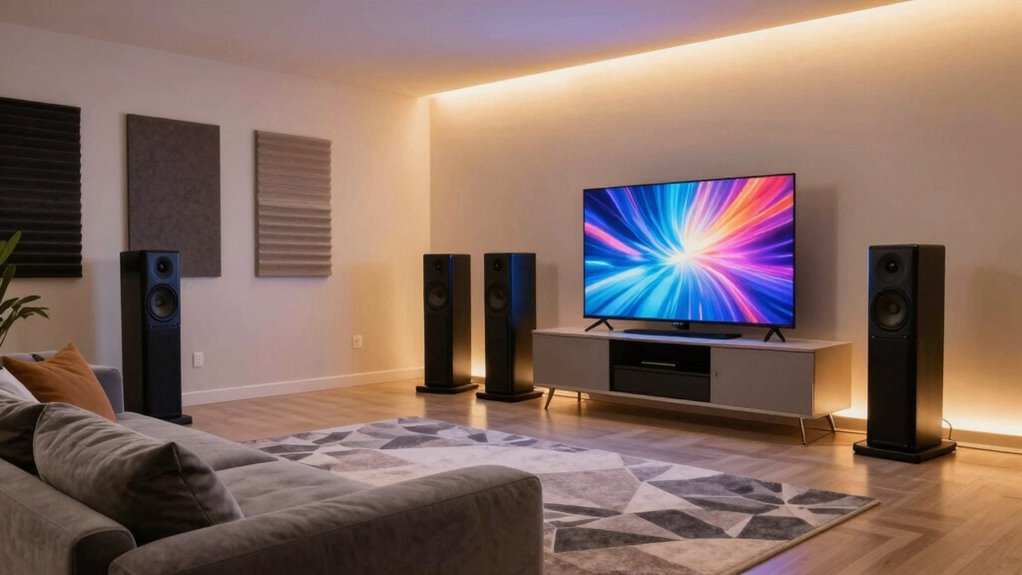

To build a better surround sound experience at home, start by placing your front speakers at ear level, equidistant from your listening spot, with a center channel directly above or below the TV. Position surround speakers slightly behind and to the sides, at or above ear level. Use acoustic treatments like rugs, curtains, and wall panels to reduce echoes and bounce. Fine-tuning these elements enhances clarity and immersion—keep exploring to discover even more, and perfect your setup.
Key Takeaways
- Properly position speakers at ear level and equidistant from the listening area for balanced sound.
- Use acoustic treatments like rugs, curtains, and panels to reduce reflections and echoes.
- Place surround speakers slightly behind and above ear level for immersive sound positioning.
- Manage room acoustics with bass traps and reflection points to enhance clarity and sound quality.
- Regularly experiment with placement and treatments to optimize your home surround sound environment.
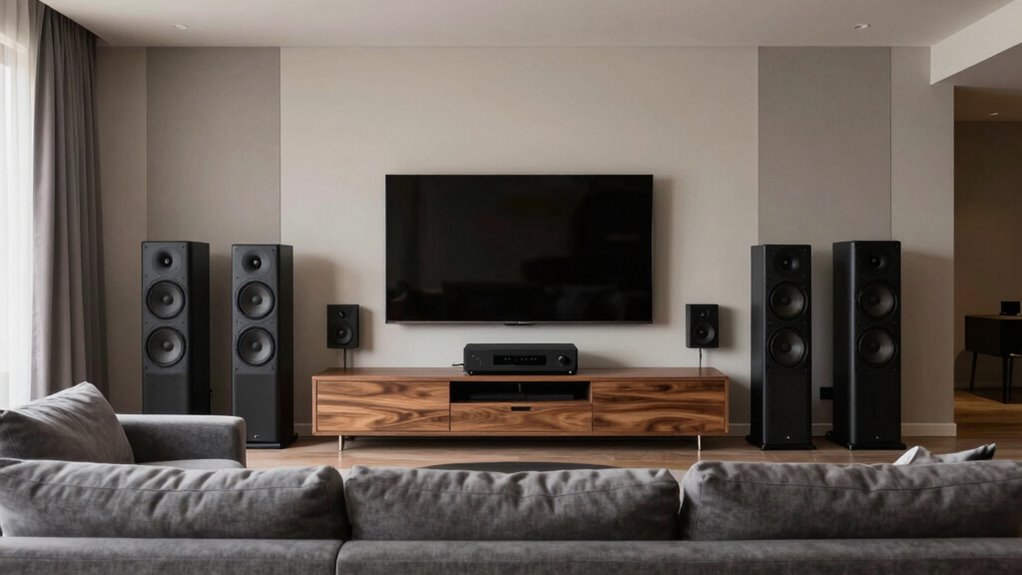
Ever wondered how to transform your home entertainment into an immersive audio experience? The key lies in smart setup and optimizing your environment. To start, focus on speaker placement. Proper positioning is vital to guarantee balanced sound and a true surround experience. You want your front left and right speakers at ear level, equidistant from your listening position, forming a straight line with your TV or screen. The center channel should be directly above or below your display, aimed at your ears, so dialogue sounds clear and natural. Surround speakers should be placed slightly behind and to the sides of your seating area, at ear level or slightly above. The goal is to create a seamless sound field where audio cues come from all directions, immersing you in the scene. Keep in mind that distance and height matter; speakers too far apart can cause sound delay, while those too close might cause sound imbalance. Experiment with placement to find the sweet spot that offers even sound coverage.
Once your speakers are positioned correctly, turn your attention to acoustic treatments. Your room’s acoustics can make or break your surround sound experience. Hard surfaces like glass, tile, or bare walls tend to reflect sound, causing echoes and muddiness. To counteract this, add acoustic treatments such as rugs, curtains, or wall panels designed to absorb excess sound waves. These treatments help to reduce reverberation, clarify dialogue, and improve overall sound quality. Consider placing bass traps in corners to manage low-frequency resonance and acoustic panels at reflection points to minimize sound bouncing around the room. The goal is to create a balanced acoustic environment where sound waves are absorbed and diffused evenly, allowing every detail in your audio to shine through. Additionally, understanding room acoustics and how they influence sound can significantly enhance your setup. It’s also helpful to leverage acoustic treatments tailored to your space, which can make a noticeable difference. Recognizing the importance of sound absorption can help you make more informed decisions about your room setup. Remember that the placement of acoustic panels can influence the overall sound quality, so experimenting with different locations can yield the best results.
Building a better surround sound system isn’t just about high-quality speakers or expensive equipment; it’s about how you set everything up. Proper speaker placement ensures that sound reaches your ears from the right directions and distances. Meanwhile, acoustic treatments help maintain clarity by controlling how sound waves behave within your room. Creating an optimal listening environment can greatly enhance your audio experience and make your home feel more like a personal cinema. When both elements work together, your home transforms into a cinematic space where every sound feels natural, immersive, and lifelike. Take the time to experiment with placement and treatments, and you’ll soon enjoy a surround sound experience that feels as if it’s happening right in your living room.

Dynasty PROAUDIO WSA-5RP-PLUS Wireless Surround Sound Rear Speakers Kit with 2 x 100W Amplifier Built-in (Metal Chassis Design)
[Lossless Audio & low Interference] latest wireless audio technology that supports 5.2 & 5.8GHz dual-band selectable digital wireless…
As an affiliate, we earn on qualifying purchases.
As an affiliate, we earn on qualifying purchases.
Frequently Asked Questions
How Do I Optimize Speaker Placement for Best Sound?
To optimize speaker placement for the best sound, focus on proper speaker positioning and sound diffusion. Place your speakers at ear level and form an equilateral triangle with your listening position to guarantee balanced sound. Avoid placing speakers too close to walls to prevent echo and sound distortion. Use sound diffusion techniques, like diffusers or soft furnishings, to scatter sound waves evenly, creating a richer, more immersive surround sound experience.
What Is the Ideal Room Size for Surround Sound?
The ideal room size for surround sound is around 150 to 300 square feet, as this range offers enough space for best speaker placement. Did you know that a well-designed home theater with proper soundproofing can improve audio clarity by up to 50%? Smaller rooms tend to cause sound reflections, while larger ones may require more powerful speakers. Focus on balancing size with soundproofing to create an immersive experience.
How Can I Reduce Echo and Improve Acoustics?
To reduce echo and improve acoustics, you should incorporate soundproofing techniques like adding rugs, curtains, and furniture to absorb sound. Use acoustic treatment options such as foam panels or bass traps on walls and ceilings to minimize reflections. These adjustments help create a balanced sound environment, making your surround sound system more immersive. Regularly repositioning speakers and avoiding hard, reflective surfaces also enhance overall audio clarity.
What Types of Cables Are Best for Surround Sound?
For surround sound, you should opt for high-quality HDMI or speaker cables, as they offer excellent signal transfer and durability. HDMI cables support high-definition audio and video, reducing signal interference, while sturdy speaker cables with thick insulation resist damage and minimize signal loss. Avoid cheap or thin cables, as they can cause interference, degrade sound quality, and wear out quickly. Investing in durable, well-shielded cables guarantees a reliable, immersive surround sound experience.
How Do I Calibrate My System for Balanced Audio?
To calibrate your system for balanced audio, start with speaker calibration using an auto-setup microphone or manual adjustments. Focus on audio tuning by adjusting volume levels, distances, and equalizer settings to guarantee all speakers produce cohesive sound. Use your receiver’s calibration tools or a sound meter app to fine-tune the balance. Regularly revisit and tweak these settings to maintain ideal surround sound performance and immersive listening.

50 Pack Sound Proof Foam Panels for Walls, 2 X 12 X 12 Inches Acoustic Foam Panels, High Density Acoustic Panels Sound Absorbing, Noise Cancelling Studio Wedges, Black (NOT INCLUDE ADHESIVE)
PROFESSIONAL SOUND ABSORBING PROPERTIES – Our acoustic foam panels are expertly designed to reduce noise pollution by absorbing…
As an affiliate, we earn on qualifying purchases.
As an affiliate, we earn on qualifying purchases.
Conclusion
By choosing the right equipment, optimizing your room, and fine-tuning your settings, you create an immersive, balanced, and dynamic sound environment. Focus on placement, calibration, and quality to elevate your home theater experience. Embrace the process of improvement, experiment with configurations, and enjoy the journey of perfecting your surround sound. Ultimately, a better surround sound system isn’t just about equipment—it’s about passion, patience, and persistence. Make your sound experience unforgettable, and let every moment resonate with clarity and power.

8 Pack – Bass Traps Acoustic Foam Corner, 8''x8''x12'' Black Bass Traps Corner Studio Foam, High Density and Fire-Proof Acoustic Panels Recording Studio Acoustical Treatments
Acoustic Principle- Bass Trap is a kind of sound absorbing structure specially used to absorb specific low-frequency standing…
As an affiliate, we earn on qualifying purchases.
As an affiliate, we earn on qualifying purchases.

SANUS Speaker Stands Pair for Satellite & Bookshelf Speakers up to 3.5lbs – 10” Height Adjustment – Includes L-Shaped Bracket & Keyhole Adapter for Compatibility – Easy DIY Assembly
Height Adjustable: Customize your sound thanks to 10 inches of height adjustment. Now you can mount your speakers…
As an affiliate, we earn on qualifying purchases.
As an affiliate, we earn on qualifying purchases.