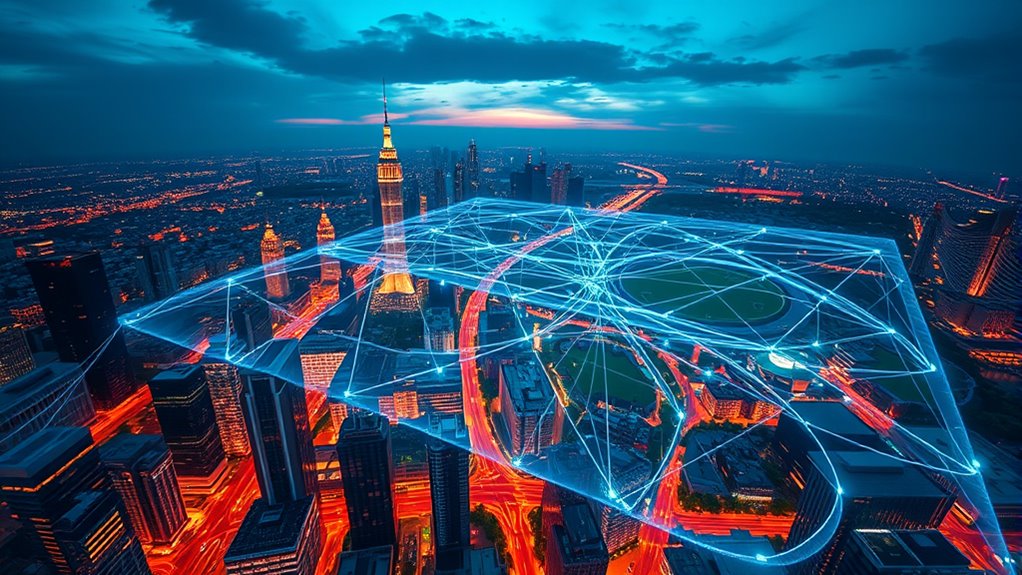

Digital twins for smart cities create virtual models that mirror real urban environments, letting you analyze and simulate city operations in real-time. By integrating data from sensors, IoT devices, and sensors, you can quickly spot issues like traffic jams or infrastructure problems and test solutions before implementing them. This technology helps you plan smarter, respond faster, and build more resilient cities. Keep exploring to uncover how digital twins could reshape your urban future.

Get travel and outdoor gear delivered free with Prime
- Fast, free delivery on millions of items
- Prime Video, Amazon Music and more included
- Member-only deals all year
Key Takeaways
- Digital twins create virtual city models for real-time monitoring, planning, and management of urban infrastructure and services.
- Integration of sensor and IoT data ensures accurate, up-to-date digital representations of city conditions.
- They enable simulation and scenario testing to optimize urban development, traffic flow, and emergency responses.
- Real-time data updates improve decision-making and facilitate proactive responses to disruptions and natural disasters.
- Digital twins support smarter city planning, enhance resilience, and help map tomorrow’s urban life with predictive insights.

Have you ever wondered how cities can become smarter and more efficient? The answer lies in deploying innovative technologies like digital twins, which create virtual replicas of urban environments. These digital models allow city planners and officials to simulate, analyze, and optimize urban systems in real time. By doing so, they enhance urban resilience, making cities better prepared to handle challenges like natural disasters, traffic congestion, or infrastructure failures. Central to this process is data integration, where information from various sources—such as sensors, cameras, and IoT devices—is combined to form a comprehensive picture of the city’s current state. This integrated data feeds into the digital twin, enabling dynamic updates and accurate simulations that reflect real-world conditions.
As you explore the concept further, you’ll see that data integration is crucial for creating a detailed, holistic view of urban life. It pulls together data from traffic sensors, weather stations, utility meters, and public transportation systems, among others. When integrated seamlessly, this data allows the digital twin to provide insights that were previously impossible to achieve with traditional methods. For instance, if there’s an unexpected spike in traffic, the digital twin can immediately analyze the cause, predict future congestion points, and suggest alternative routes or traffic management strategies. This proactive approach helps cities respond quickly to disruptions, improving overall urban resilience.
Moreover, digital twins facilitate scenario testing, where you can simulate the impact of various interventions before implementing them in the real world. Whether it’s assessing the effects of new construction projects or planning for emergency responses, these virtual models give you a safe environment to experiment and refine solutions. This is especially useful in increasing urban resilience, as it allows cities to prepare for extreme weather events, infrastructure stress, or population surges with minimal risk. The ability to visualize and analyze potential outcomes in a simulated space leads to smarter decision-making, saving time and resources. Additionally, real-time data updates from sources like sensors and IoT devices are vital for maintaining the accuracy and usefulness of digital twins in dynamic urban environments.
digital twin software for smart cities
As an affiliate, we earn on qualifying purchases.
As an affiliate, we earn on qualifying purchases.
Frequently Asked Questions
How Do Digital Twins Impact City Governance and Decision-Making?
Digital twins greatly influence city governance and decision-making by enhancing urban planning and boosting public engagement. You can simulate scenarios, identify potential issues, and optimize resource allocation more effectively. This technology allows you to involve residents in planning processes, making decisions more transparent and data-driven. As a result, you improve city management, respond swiftly to challenges, and create smarter, more sustainable urban environments that reflect community needs.
What Are the Privacy Concerns Associated With Digital Twins in Urban Environments?
Imagine your city uses a digital twin to monitor traffic flow, but sensitive data like personal info of commuters is collected. You might worry about data security breaches or unauthorized access. Privacy concerns rise if privacy regulation isn’t strict or enforced, risking misuse of data. Ensuring secure data handling and clear privacy policies is essential to protect citizens’ rights in such urban digital environments.
How Cost-Effective Are Digital Twins for Developing Smart City Infrastructure?
You’ll find that digital twins are quite cost-effective for developing smart city infrastructure. They enable you to simulate and analyze urban systems, leading to significant cost savings by identifying issues early and optimizing budgets. With digital twins, you can better allocate resources, streamline planning, and improve decision-making, ultimately maximizing your investment. This technology helps you create more efficient urban environments while keeping costs manageable, making it a valuable tool for smart city development.
What Are the Technical Challenges in Creating Comprehensive City Digital Twins?
Creating all-encompassing city digital twins presents several technical challenges. You need to handle data integration from diverse sources like sensors, cameras, and GIS systems, which can be complex. Ensuring real-time modeling is another hurdle, requiring robust processing power and reliable connectivity. You also face difficulties in maintaining data accuracy, security, and scalability, all essential for building an effective and dynamic digital twin that reflects the city’s evolving landscape.
How Can Digital Twins Adapt to Rapid Urban Growth and Change?
Imagine you’re in the 19th century, witnessing rapid industrial changes. To adapt to urban growth today, digital twins must be flexible, continuously updating data to reflect evolving infrastructure. You need real-time monitoring, scalable models, and predictive analytics to anticipate future needs. By integrating new data sources and leveraging AI, digital twins can help you manage infrastructure adaptation efficiently, ensuring cities grow sustainably and resiliently amid constant change.
Conclusion
By embracing digital twins, you’re opening the door to smarter, more responsive cities. These virtual models help you anticipate issues, optimize resources, and improve urban life. As the saying goes, “a stitch in time saves nine,” meaning early intervention makes all the difference. So, don’t wait on the sidelines—adopt this technology now and stay ahead of the curve. The future of urban living is just a digital twin away!
Halloween Picks
halloween
As an affiliate, we earn on qualifying purchases.