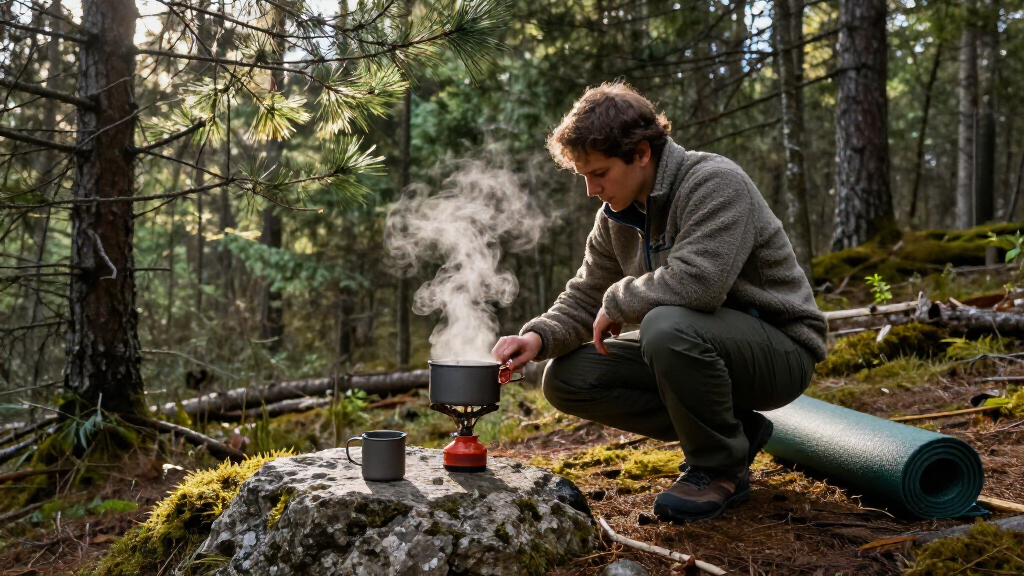

Choosing a portable camping stove is largely a choice between a quick, light setup and a stove built to handle more demanding conditions. Canister stoves connect to a pressurized fuel canister and are popular for their easy operation and compact kits. Liquid-fuel stoves use refillable bottles, often with white gas, and typically need priming and occasional maintenance.

Get travel and outdoor gear delivered free with Prime
- Fast, free delivery on millions of items
- Prime Video, Amazon Music and more included
- Member-only deals all year

Coleman Triton 2-Burner Propane Camp Stove
- ✔ Fuel type: Propane
- ✔ Burners: 2 independently adjustable
- ✔ Total cooking power: 22,000 BTU

Gas One GS-3400P Portable Dual Fuel Camping Stove with Carrying Case
- ✔ Model: GS-3400P
- ✔ Fuel types: Butane or propane
- ✔ Butane capacity: 8 oz cartridge

Gas One GS-1000G Portable Butane Camping Stove with Carrying Case
- ✔ Model: GS-1000G
- ✔ Heat output: 7,650 BTU
- ✔ Fuel type: 8 oz butane canister, sold separately
For weekend camping, backpacking, and straightforward meals, canister models are usually the more convenient fit. Liquid-fuel models make a stronger case for winter trips, extended travel, or places where compatible canisters are difficult to buy. The right choice depends less on a headline boil time than on your temperatures, trip length, fuel access, and tolerance for setup and upkeep.
At a Glance
| Criteria | Canister camping stoves | Liquid-fuel camping stoves | Winner |
|---|---|---|---|
| Weight and packability | Usually lighter and more compact, especially integrated systems | Usually heavier and bulkier because of the fuel bottle and pump | A |
| Setup and ease of use | Fast setup; attach canister, open valve, ignite, and adjust | More steps; many models require pumping, priming, and careful lighting | A |
| Cold-weather performance | Can lose pressure and output in freezing conditions unless designed for cold use | Generally stronger in low temperatures, subject to fuel and model | B |
| Fuel availability and flexibility | Requires the compatible canister type; availability varies by destination | Refillable bottles and multiple fuel types can make resupply easier in some regions | B |
| Trip-length value | Canister cost and leftover fuel can add up across long or frequent trips | Refillable fuel can be economical over repeated or extended use | Depends |
| Maintenance and reliability | Little routine maintenance, but canisters are disposable and must be carried out | Needs cleaning and occasional pump or seal service; field repair may be possible | A |
| Cooking control | Often good simmer control, though small burners can be exposed to wind | Often stable for larger pots, but performance and simmering vary by model | Depends |
Coleman Triton 2-Burner Propane Camp Stove
When a campsite meal involves a pot and a skillet at the same time, the Coleman Triton has a practical advantage over both Gas One single-burner models: its two burners can be adjusted independently. Its 22,000 BTU combined output supports a broader cooking setup, and capacity for a 12-inch and 10-inch pan side by side gives that power a useful purpose. Built-in wind guards help shield the flames, a benefit the Gas One models do not list.That added capacity takes more room and ties the stove to propane only. The Triton also runs for up to an hour on high with a 16 oz cylinder, sold separately, so longer or higher-heat cooking may mean carrying additional fuel. Compared with the GS-3400P, it cannot switch to butane; compared with the GS-1000G, it serves more ambitious meals but is less suited to a minimal one-burner kit. The removable grate and heavy-duty latch support campsite cleanup and transport, though buyers prioritizing a compact cooking setup may find its second burner unnecessary.
Pros:
- Two independently adjustable burners support simultaneous cooking.
- 22,000 BTU combined output and room for 12-inch and 10-inch pans.
- Wind guards help shield the burners in breezy conditions.
- Removable grate and heavy-duty latch support cleanup and transport.
Cons:
- Uses propane only; the cylinder is sold separately.
- Runs up to one hour on high with a 16 oz cylinder, so extended cooking requires fuel planning.
- Two-burner capacity takes more space than a single-burner stove.
Best for: Campers who regularly cook with two pans and want independent burner controls for separate dishes.
Not ideal for: Solo campers or space-conscious packers who only need one burner, or anyone who wants the option to use butane.
Bottom line: For campers who cook full meals with multiple pans, the Triton is the most versatile cooker here, provided its propane needs and larger two-burner setup suit the trip.
“For campers who cook full meals with multiple pans, the Triton is the most versatile cooker here, provided its propane needs and larger two-burner setup suit the trip.”
Gas One GS-3400P Portable Dual Fuel Camping Stove with Carrying Case
The GS-3400P earns its place through fuel flexibility: it accepts an 8 oz butane cartridge or a 16.4 oz propane cylinder, and a propane converter regulator is included. That gives campers a choice between two common fuel formats instead of the propane-only Coleman Triton or butane-only GS-1000G. For trips where availability or packing preferences can vary, this versatility is the clearest reason to choose it.As a single-burner stove, it does not match the Triton for cooking a meal in two pans at once. Its automatic piezo ignition and adjustable heat dial keep operation straightforward, while the included carrying case makes it easier to store and transport. The pressure-sensor cartridge ejection and gas flow cut-off features apply in butane mode; buyers should not assume those protections carry over to propane use. Fuel is not included, and the supplied details do not state a heat output or burn time, so we would not choose it over the Triton based on cooking power. It makes more sense than the GS-1000G when the ability to switch fuels matters more than a dedicated butane setup.
Pros:
- Accepts both 8 oz butane cartridges and 16.4 oz propane cylinders.
- Includes the propane converter regulator and a carrying case.
- Automatic piezo ignition and an adjustable heat dial simplify use.
- Butane mode includes pressure-sensor cartridge ejection and gas flow cut-off features.
Cons:
- Single burner cannot cook with two pans simultaneously like the Coleman Triton.
- Fuel is not included.
- The stated ejection and gas cut-off protections are for butane mode.
Best for: Campers who want one portable stove that can use either butane cartridges or propane cylinders.
Not ideal for: People who need two burners, or buyers who want safety ejection features to apply across both fuel modes.
Bottom line: The GS-3400P is the most adaptable single-burner choice in this group when switching between butane and propane is more useful than having a second burner.
“The GS-3400P is the most adaptable single-burner choice in this group when switching between butane and propane is more useful than having a second burner.”
Gas One GS-1000G Portable Butane Camping Stove with Carrying Case
For a simple stove-and-pan setup, the GS-1000G pairs a single butane burner with a carrying case and automatic ignition. Its 7,650 BTU output is presented as suitable for fast boiling and outdoor cooking, making it a sensible match for boiling water or preparing a straightforward meal. The case and one-burner format keep the kit focused; the Coleman Triton offers much more cooking capacity but has two burners to transport and fuel.This is the most limited pick in fuel choice: it runs on 8 oz butane canisters only, which are sold separately. The GS-3400P is a better fit if you might want propane as an alternative, while the Triton is more capable for cooking two dishes at once. The GS-1000G instead keeps the controls straightforward with piezo ignition and precise heat control. It is listed for outdoor use only, and its automatic canister ejection activates if excessive force is detected. That safety feature should be considered alongside the stove’s stated use and instructions, not as a replacement for proper handling.
Pros:
- 7,650 BTU output for boiling and outdoor cooking.
- Piezo automatic ignition and precise heat control.
- CSA listed with automatic canister ejection if excessive force is detected.
- Carrying case and user manual are included.
Cons:
- Uses 8 oz butane canisters only, sold separately.
- Listed for outdoor use only.
- Less suited to simultaneous cooking than the two-burner Coleman Triton.
Best for: Campers who want a straightforward, portable butane stove for boiling water or preparing simple meals outdoors.
Not ideal for: Anyone needing two burners, propane compatibility, or a stove intended for indoor use.
Bottom line: The GS-1000G is a focused, portable choice for basic outdoor cooking if butane is convenient and one burner is enough.
“The GS-1000G is a focused, portable choice for basic outdoor cooking if butane is convenient and one burner is enough.”
As an Amazon Associate we earn from qualifying purchases.
Key Differences
The biggest practical gap is convenience versus adaptability. A canister stove is usually ready to cook with little preparation, and its lower weight suits a compact backpacking kit. That simplicity matters on short trips, where the stove may be used only to boil water or prepare basic meals. The tradeoff is dependence on a specific canister and weaker performance in cold weather for many standard models.
Liquid-fuel stoves ask for more attention: users may need to pump the bottle, prime the burner, and clean components over time. In return, many models keep working well in cold conditions and can use refillable fuel supplies that are easier to obtain in some remote destinations. Their extra weight and upkeep pay off most for winter travel, long expeditions, or frequent use. For ordinary fair-weather camping, the added capability often brings little benefit.
Detailed Comparison
Weight and packability (Canister camping stoves wins — moderate)
Canister stoves generally win on weight and packed size, especially simple burner-on-canister designs. Integrated systems can also keep the pot and burner together. Liquid-fuel stoves need a pump and bottle, so the complete setup is commonly bulkier. This is a moderate advantage for canisters on backpacking trips; car campers may care little about the difference.
Setup and ease of use (Canister camping stoves wins — major)
Canister stoves are usually easier to start: connect the stove, open the valve, and ignite according to the manufacturer’s instructions. Liquid-fuel models involve more steps and a learning curve, particularly when priming. The gap is major for new campers or anyone who values quick meals and minimal fuss. Experienced users may find the routine manageable.
Cold-weather performance (Liquid-fuel camping stoves wins — major)
Liquid-fuel stoves generally have the advantage when temperatures are low because the fuel system can maintain useful output where some canisters struggle. Cold-weather canister models and appropriate operating techniques can narrow the difference, so check the stove’s instructions and conditions. The gap is major for regular winter trips, but minor for camping in mild weather.
Fuel availability and flexibility (Liquid-fuel camping stoves wins — moderate)
Canister stoves depend on compatible canisters, which can be inconvenient to find in small towns, at remote trailheads, or abroad. Liquid-fuel stoves may accept more than one fuel, depending on the model, and refillable bottles can simplify resupply on long routes. Liquid fuel wins by a moderate margin for international travel or remote expeditions. On familiar routes with reliable outdoor shops, canisters are easy to plan around.
Trip-length value (moderate difference)
There is no universal cost winner. Canister systems avoid a larger initial commitment and are convenient for occasional use, but you buy replacement canisters and may carry fuel that remains unused. Liquid-fuel stoves often cost more upfront and require care, while refillable fuel can make sense over frequent or extended trips. The difference depends on local fuel prices, usage, and resupply, so compare total kit and fuel costs for your actual plans.
Maintenance and reliability (Canister camping stoves wins — moderate)
Canister stoves have fewer routine service tasks, giving them an edge for users who want a low-maintenance appliance. Liquid-fuel models have pumps, seals, and fuel lines that may need cleaning or replacement, though repairable parts can be useful away from resupply. The gap is moderate: low upkeep favors casual trips, while repairability may matter more on long journeys.
Cooking control (minor difference)
Neither fuel system guarantees better cooking. Many canister burners offer responsive simmer control, but compact models may be less stable with wide pots or vulnerable to wind. Liquid-fuel stoves can provide a stable platform for larger cookware, while simmering performance varies substantially by model. This is a minor, model-specific difference; compare burner design, pot support, wind protection, and user guidance for the meals you cook.
Canister camping stoves: Pros and Cons
Pros:
- Light and compact for backpacking
- Quick setup with little routine maintenance
- A convenient choice for short trips and simple meals
Cons:
- Fuel depends on compatible canisters being available
- Many standard models lose performance in freezing conditions
- Ongoing canister purchases may cost more with frequent use
Liquid-fuel camping stoves: Pros and Cons
Pros:
- Often performs well in cold weather
- Refillable fuel and some models’ fuel flexibility suit extended travel
- Parts may be serviceable in the field
Cons:
- Heavier and bulkier to carry
- Priming and operation take practice
- Needs more cleaning and maintenance
Who Should Choose What
Choose Canister camping stoves if:
- You mostly camp in mild weather and want a stove that is quick to set up.
- You backpack and want to keep your cooking kit light.
- You cook simple meals and can reliably buy compatible canisters.
Choose Liquid-fuel camping stoves if:
- You camp in freezing conditions often enough that cold performance matters.
- You take long trips or travel where compatible canisters are hard to find.
- You use a stove frequently and value refillable fuel and serviceable parts.
Skip both if: You mostly camp at established sites with fire restrictions or want a full-size cooking setup; compare electric or larger camp stoves based on your power access, cooking needs, and local rules.
Value for Money
For occasional summer camping, a canister stove is usually the better value even if its fuel costs more per trip: the lighter kit, simple operation, and minimal upkeep deliver benefits each time you use it. Paying extra for a liquid-fuel setup makes sense when its cold-weather performance, refillable fuel, or serviceability solves a recurring problem. For frequent or extended use, compare the stove’s purchase price, fuel costs, maintenance parts, and the cost of carrying its heavier kit. A liquid-fuel stove is not automatically cheaper just because its fuel is refillable.
Final Verdict
Choose a canister stove for the broadest range of ordinary camping and backpacking: it is lighter, easier to use, and asks less of you before dinner. Choose liquid fuel if you regularly camp in the cold, travel far from reliable canister supplies, or need a stove that can be serviced on a long trip. The biggest deciding factor is whether those demanding conditions are part of your actual plans. If they are occasional exceptions, the added weight and upkeep of liquid fuel are hard to justify; if they define your trips, its adaptability is worth paying for.
Frequently Asked Questions
Which type of camping stove is better for beginners?
Canister stoves are generally easier to learn because setup and lighting involve fewer steps. Follow the model’s instructions and use it only in suitable, well-ventilated outdoor conditions.
Can a canister stove work in winter?
Some canister stoves are designed for cold-weather use, but performance varies with temperature, fuel, and setup. Check the manufacturer’s guidance for the specific model and conditions; a liquid-fuel stove is often the more dependable choice for repeated freezing-weather trips.
Is a liquid-fuel stove cheaper over time?
It can be for frequent or extended use when refillable fuel is affordable and easy to obtain. The higher initial cost, maintenance, and extra weight can offset that advantage for occasional campers, so compare the full cost of your expected use.
Which stove should I take on an international trip?
Check fuel access along your route before choosing. Liquid-fuel models that accept locally available fuels can be easier to resupply in some regions, while compatible canisters may be simple to find in others. Confirm the exact fuel and stove restrictions for your destination.
Fall Picks
fall essentials
As an affiliate, we earn on qualifying purchases.