
Prices ending in 7 appeal to your subconscious because they create a perception of savings and exclusivity, making you feel you’re getting a better deal. This subtle cue taps into ingrained biases, triggering quicker buying decisions and reducing hesitation. Marketers use this strategy intentionally to boost conversions, knowing that such endings influence your perception of value. Keep exploring, and you’ll discover more about how these clever tactics shape your purchasing choices.
Key Takeaways
- Prices ending in 7 evoke feelings of savings and exclusivity, prompting quicker purchase decisions.
- The number 7 appears as a psychologically appealing, balanced digit between round and arbitrary numbers.
- Ending prices in 7 subtly signal discounts, increasing perceived value and influencing consumer behavior.
- Such pricing cues leverage subconscious biases, reducing hesitation and boosting conversion rates.
- Strategic use of ending in 7 helps marketers shape perceptions of affordability and quality.
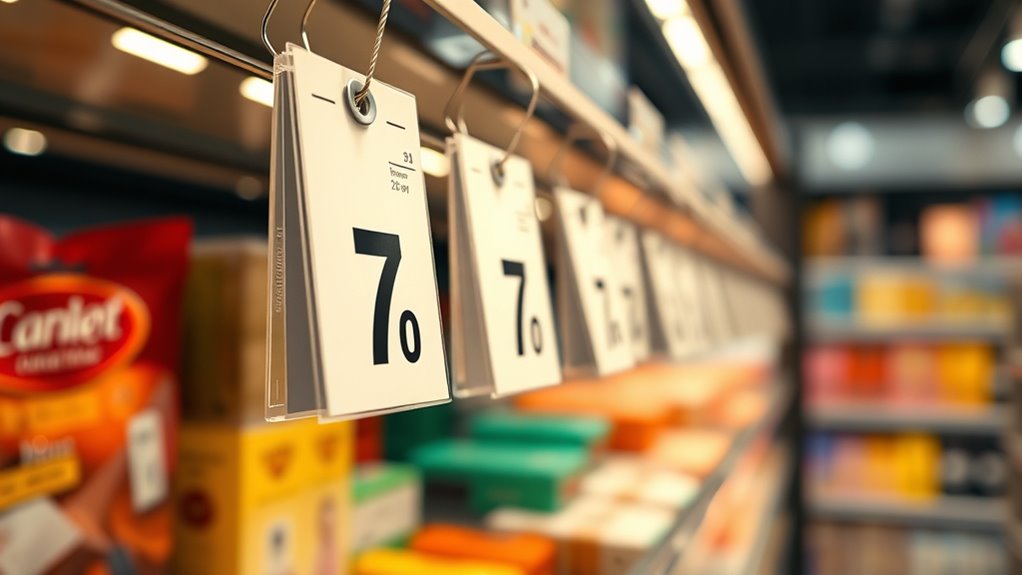
Have you ever wondered why certain prices seem more appealing than others? It turns out, our perception of value plays a huge role in how we respond to price tags. When you see a product priced at $19.99 instead of $20.00, your brain doesn’t just register the number; it perceives a better deal. This is no accident. The concept of perceived value is a powerful driver in consumer behavior. We tend to associate prices ending in 7 or 9 with discounts or special offers, which makes us more inclined to buy. Retailers have long known this trick, and they use it to influence your purchasing decisions, often without you even realizing it.
Why does ending prices in 7 seem to make a difference? It’s rooted in cognitive biases and how your brain processes numbers. Prices ending in 7 or 9 tend to seem more precise, more thoughtfully set, and even more affordable. The number 7, in particular, has a subtle psychological pull—it’s neither too round nor too arbitrary. When you see a price like $14.97, your mind perceives it as a better deal than $15.00, because of the way you interpret the number as slightly discounted or more tailored to your budget. This perception is reinforced through consumer behavior, where such endings trigger a subconscious belief that you’re getting a bargain.
Prices ending in 7 or 9 seem more precise and affordable, subtly encouraging you to see them as better deals.
This pattern is also supported by the psychology of perception, which influences how consumers interpret numerical cues on price tags. Your buying decisions are also influenced by the way pricing signals are sent. Endings in 7 tend to evoke feelings of savings or exclusivity, prompting you to act quickly. Retailers know that these small cues can profoundly impact your willingness to convert from just browsing to making a purchase. It’s not just about the actual discount but how your mind interprets the value being offered. When prices end in 7, they seem more “just right,” striking a balance between affordability and quality. This perception nudges you toward a quicker decision, reducing hesitation and increasing the likelihood of a purchase.
In essence, the psychology of pricing taps into your subconscious biases and perceptions. As a consumer, you’re influenced by how prices are presented, often without realizing it. Marketers leverage this knowledge by choosing ending digits that resonate with your mind’s expectations of value and savings. So next time you see a price ending in 7, remember—it’s more than just a number; it’s a strategic move designed to influence your behavior and boost conversions. Understanding these subtle cues helps you become a smarter shopper and recognizes how pricing psychology shapes your buying habits.
Top picks for "psychology pric number"
Open Amazon search results for this keyword.
As an affiliate, we earn on qualifying purchases.
Frequently Asked Questions
Do Cultural Differences Affect the Perception of Ending Numbers?
Cultural differences do influence how you perceive ending numbers, as cultural numerology shapes regional pricing perceptions. In some cultures, certain numbers like 7 are seen as lucky, making prices ending in 7 more appealing. Elsewhere, other numbers hold significance. You should consider these regional and cultural nuances when pricing products, because they can markedly impact how your customers perceive the value and appeal of your prices.
How Do Pricing Endings Influence Customer Trust and Brand Loyalty?
Think of pricing endings as a bridge connecting you to customer trust and brand loyalty. When you choose endings that evoke perceived value and emotional appeal, you craft a melody that resonates deeply. Customers see your prices as honest and thoughtful, strengthening their confidence. This emotional connection turns buyers into loyal fans, trusting your brand’s integrity. Ultimately, smart pricing endings build lasting relationships, turning one-time buyers into lifelong advocates.
Are There Specific Industries Where Ending in 7 Is More Effective?
You’ll find that ending prices in 7 works especially well in discount strategies across retail and consumer goods, enticing customers with perceived savings. In luxury branding, it’s less common, as high-end brands prefer precise, clean pricing to convey exclusivity. So, if you’re targeting mass-market affordability or promotional campaigns, using ending numbers in 7 can boost conversions. But in luxury, focus on clarity and prestige instead.
Can Pricing Endings Impact Online vs. In-Store Shopping Behaviors?
Imagine the thrill of online shopping versus the tactile feel of in-store browsing. You notice that pricing endings in 7 can influence your choices differently across these environments. The digital impact affects your sensory perception, making online prices seem more appealing or less trustworthy. In-store, you rely on physical cues, so ending numbers might have less influence. Your behavior shifts based on how your senses and perceptions are engaged in each setting.
How Do Psychological Pricing Strategies Vary Across Different Demographics?
You’ll notice that different demographics respond uniquely to pricing strategies. For example, younger shoppers may be more attracted to prices ending in 7 due to perceived value, while older consumers might focus on total cost and price sensitivity. Understanding these demographic preferences helps you tailor your pricing approach, making it more effective. By adjusting strategies based on age, income, or shopping habits, you increase your chances of driving conversions and satisfying diverse customer needs.
Conclusion
By now, you see how ending prices with a 7 can supercharge your conversions—it’s like revealing a secret code to consumer minds. Don’t underestimate the power of a simple number; it could be the difference between a sale and a missed opportunity. Use this tweak wisely, and watch your revenue skyrocket faster than you ever imagined. Remember, in the world of pricing, that little 7 holds the magic to opening incredible success—so start experimenting today!