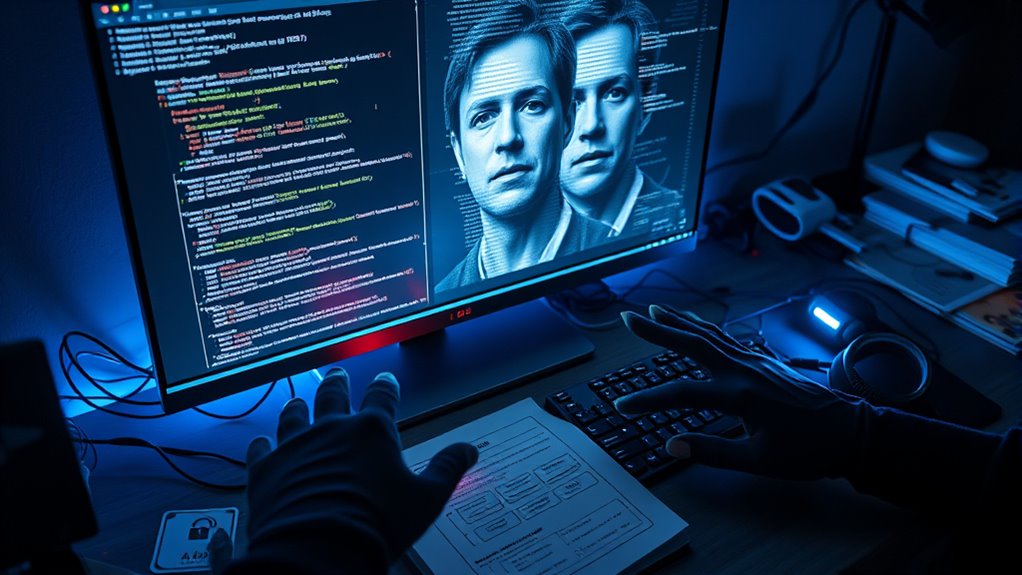

Deepfakes threaten your trust by making it hard to tell what’s real, fueling misinformation and malicious manipulation. They enable false narratives, influence opinions, and even sway elections, all while being increasingly difficult to detect. Thankfully, tech developers are working on tools that analyze subtle inconsistencies and verify media authenticity, trying to keep pace with fake content. If you want to uncover how these countermeasures work and stay protected, there’s more to explore.
Key Takeaways
- Deepfakes threaten trust by enabling realistic misinformation campaigns that manipulate public opinion and undermine media credibility.
- Malicious actors exploit deepfakes to spread false narratives, influence elections, and tarnish reputations rapidly.
- Detection tools analyze inconsistencies, artifacts, and digital signatures, but sophisticated deepfakes challenge these defenses.
- The ongoing arms race between deepfake creation and detection complicates verification, requiring continuous technological updates.
- Vigilance, media verification, and policy regulations are essential to combat the risks posed by deepfake technology.
Deepfakes have emerged as a powerful tool that can convincingly manipulate audio and video content, posing significant challenges to trust and information integrity. These synthetic manipulations make it easier than ever for malicious actors to create false narratives, fueling misinformation campaigns that can sway public opinion, influence elections, or tarnish reputations. When you encounter a deepfake, you’re faced with the unsettling reality that what you see or hear might not be genuine. This ability to forge realistic content raises the stakes for misinformation, as attackers leverage deepfakes to spread falsehoods rapidly and convincingly. With the surge of synthetic manipulation, identifying authentic media becomes more complex, and the risk of falling victim to deception increases exponentially.
Deepfakes threaten trust by making fake media more convincing and harder to detect.
Misinformation campaigns often exploit deepfakes to sow discord, create chaos, or manipulate market behaviors. For example, a fabricated video of a political leader making inflammatory remarks can ignite protests or sway voters, even if the footage is entirely fake. The ease of producing such content means that anyone with malicious intent can generate convincing clips that look legitimate. This not only undermines public trust but also erodes confidence in traditional media sources. As a result, you need to stay vigilant, questioning the authenticity of suspicious content and seeking verified information from trusted outlets. The rapid proliferation of deepfakes makes it difficult to distinguish truth from fiction in real-time, complicating efforts to combat misinformation campaigns. Additionally, advancements in vetted media help provide more reliable sources for verifying content authenticity.
Fortunately, researchers and technology companies are developing countermeasures to address these challenges. Detection tools now analyze subtle inconsistencies, artifacts, or anomalies that often accompany synthetic manipulation. These tools examine pixel-level details, facial movements, voice patterns, and other digital fingerprints to determine whether content has been artificially created or altered. Machine learning algorithms continuously improve, learning to spot new tactics used in deepfake generation. Additionally, digital watermarks and cryptographic signatures are being explored as ways to verify authentic media, helping you identify trusted content more easily. Policy makers and social media platforms also play a pivotal role by establishing standards and regulations to curb the spread of malicious deepfakes.
While these tools are promising, they’re not foolproof. As deepfake technology advances, so do the methods for creating more sophisticated forgeries. Your best defense remains a healthy skepticism and an awareness of the ongoing arms race between deepfake creators and countermeasures. Staying informed about recent developments, verifying sources, and using detection tools can help you navigate an environment where fake content is increasingly convincing. The fight against synthetic manipulation is ongoing, but with vigilance and technological innovation, you can better protect yourself from falling prey to the deception that deepfakes enable.
Frequently Asked Questions
How Quickly Can Deepfake Technology Be Improved to Bypass Detection?
You wonder how fast deepfake technology can evolve to bypass detection. In this technological arms race, improvements can happen rapidly, sometimes within months, as creators develop more sophisticated algorithms. This progress raises ethical dilemmas about AI misuse. Staying ahead requires continuous innovation in detection tools, but the pace of advancements means you must remain vigilant, knowing that both sides are constantly evolving to outsmart each other.
Are There Legal Consequences for Creating Malicious Deepfakes?
You should be aware that creating malicious deepfakes can have serious legal implications, including criminal charges and civil lawsuits. Ethical concerns also arise, especially when deepfakes are used to spread misinformation or harm someone’s reputation. Laws are evolving to address these issues, but if you produce harmful deepfakes, you risk significant legal consequences and ethical breaches. Always consider the moral and legal responsibilities before engaging in such activities.
Can Deepfake Detection Tools Be Fooled by Advanced AI Techniques?
You might be surprised to learn that recent studies show deepfake detection tools succeed only about 80% of the time against advanced AI techniques. As technology evolves rapidly, you face an ongoing ethical dilemma: how to stay ahead in this technological arms race. While detection tools improve, sophisticated deepfakes can still fool them, making it a constant challenge to identify false content and protect the truth.
What Industries Are Most at Risk From Malicious Deepfakes?
You should be aware that industries like media, politics, and finance are most at risk from malicious deepfakes. These industries face threats such as media manipulation and political misinformation, which can sway public opinion or damage reputations. Deepfakes make it easier to create convincing false content, so you need to stay vigilant and use detection tools to protect yourself and your organization from deceptive tactics that can have serious real-world consequences.
How Accessible Are Deepfake Creation Tools to the General Public?
You’ll find that deepfake creation tools have become surprisingly easy to access, making them available to amateur creators with minimal technical skills. Many platforms offer user-friendly interfaces, tutorials, and even free options, so you don’t need advanced training to get started. This easy accessibility means almost anyone can experiment or produce deepfakes, raising concerns about misuse and the need for effective detection tools to combat malicious content.
Conclusion
As you watch a news clip, a subtle shift in a face makes you question its authenticity—reminding you that deepfakes can blend seamlessly into reality. Yet, just as you spot the faint anomaly, new tools emerge, like a vigilant eye catching the tiniest detail. Coincidentally, these advancements in detection grow stronger as deepfakes become more convincing. It’s a constant dance—your awareness sharpening right alongside the technology fighting to keep truth visible amid the deception.