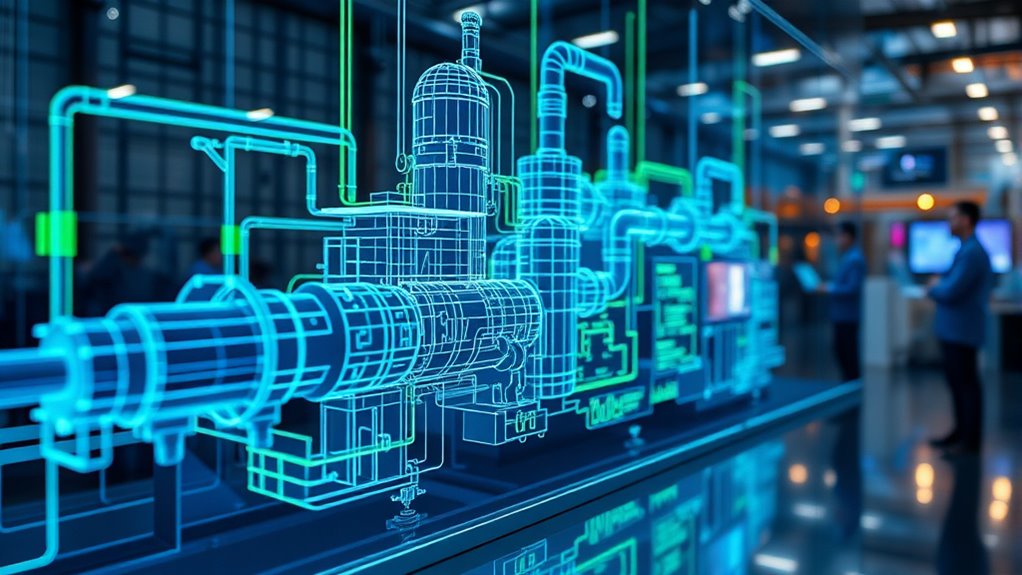

Digital twins are virtual models that replicate your physical systems in real time, allowing you to simulate, monitor, and optimize operations without physically interfering. They use sensor data, advanced analytics, and AI to mirror processes, predict issues, and improve performance across industries like manufacturing, healthcare, and smart cities. As the technology evolves, digital twins become smarter and more autonomous. Discover more about how these advanced tools transform assets and efficiency.

Get travel and outdoor gear delivered free — and shop member deals
- Fast, free delivery on millions of items
- Access to Prime Big Deal Days deals on October 6–7
- Prime Video, Amazon Music and more included
Key Takeaways
- Digital twins are virtual replicas of physical systems that mirror real-time data and behavior for simulation and analysis.
- They originated from NASA and evolved to incorporate advanced sensors, AI, and connectivity for high-fidelity modeling.
- Digital twins enable proactive maintenance, design optimization, and system monitoring across various industries.
- They range from simple status indicators to complex physics-based models supporting autonomous decision-making.
- Future developments include integration with AI and edge computing to create smarter, more responsive virtual representations.
Defining the Core Concepts and Origins of Digital Twins

Have you ever wondered how virtual models can mirror real-world objects and processes so closely? That’s the essence of digital twins. They are sophisticated, data-driven virtual replicas that continuously sync with their physical counterparts, using real-time and historical data. Digital twins enable you to simulate, monitor, and optimize systems without physical interference. The concept originated from NASA in 2010, evolving from simple physical replicas used in space exploration to complex digital models. Michael Grieves introduced the term in 2002, initially focusing on product lifecycle management. Over time, digital twins expanded across industries, integrating IT, OT, and engineering systems, to create highly accurate virtual representations. These models allow for proactive maintenance, testing, and decision-making, transforming how we manage physical assets. Additionally, automation technologies play a crucial role in enhancing the capabilities and applications of digital twins across various sectors.
Evolution and Market Expansion of Digital Twin Technologies
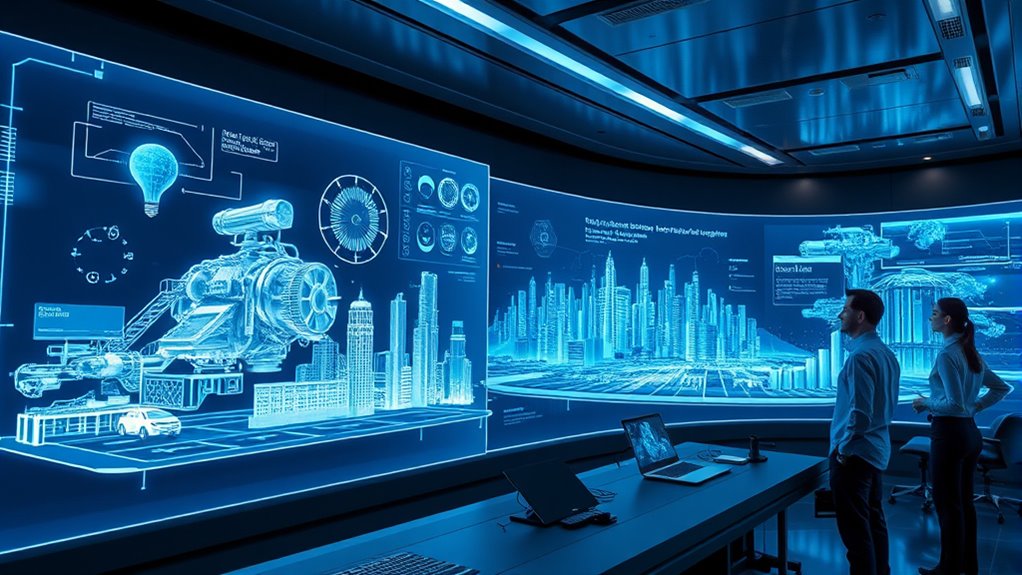
You’ve seen how digital twins evolved from physical replicas into sophisticated virtual models that mirror real-world systems. Market forecasts show explosive growth, with applications expanding across industries like healthcare, manufacturing, and smart cities. Technological advances, including AI integration and cloud computing, are accelerating this expansion and enabling more accurate, autonomous digital twin solutions.
From Physical Replicas to Virtual Models
The evolution of digital twin technologies marks a significant shift from simple physical replicas to sophisticated virtual models that seamlessly connect the physical and digital worlds. Initially, digital twins focused on basic replication—creating digital copies of physical assets for monitoring. Over time, advancements in sensors, data processing, and modeling techniques enabled these replicas to become dynamic, real-time representations. Today, digital twins integrate live data with physics-based simulations, enabling predictive insights, testing, and optimization without physical intervention. This progression has expanded their market relevance across industries like manufacturing, healthcare, and urban planning. As virtual models grow more accurate and complex, they serve as essential tools for decision-making, innovation, and efficiency, bridging the gap between physical operations and digital intelligence in ways never imagined a decade ago. The integration of AI techniques further enhances digital twin capabilities by enabling more sophisticated analysis and autonomous decision-making.
Market Growth and Forecasts
Digital twin technologies are experiencing rapid growth driven by advances in sensor technology, data analytics, and connectivity. You’ll see increasing adoption across industries such as aerospace, healthcare, smart cities, and manufacturing. The market is projected to expand considerably—from USD 24.5 billion in 2025 to an estimated USD 259.3 billion by 2032—highlighting strong global demand. As organizations seek to optimize operations, reduce costs, and improve safety, digital twins become essential tools for real-time monitoring, predictive maintenance, and simulation. The growth is also fueled by emerging capabilities like AI integration, which enhances system modeling and autonomous decision-making. Overall, the market’s evolution reflects digital twins’ essential role in transforming industries and enabling smarter, more efficient systems worldwide. Creativity can be cultivated by anyone, regardless of skill level.
Technological Advancements and Integration
Advancements in sensor technology, data analytics, and connectivity have driven significant evolution in digital twin capabilities, enabling more accurate, real-time virtual representations of physical assets. You now benefit from high-fidelity data streams, cloud and edge computing, and AI-driven modeling that improve simulation precision and predictive power. Integration of physics-based models and domain expertise enhances accuracy, while generative AI allows for complex scenario forecasting. You can connect digital twins seamlessly across IT, operational technology (OT), and engineering systems, ensuring continuous data exchange. This integration supports real-time monitoring, autonomous decision-making, and resource optimization. As connectivity infrastructures improve, digital twins become more scalable and versatile, expanding their application across industries like manufacturing, healthcare, and smart cities. These technological advancements underpin the rapid market growth and broader adoption of digital twin solutions. Utilizing bedroom concepts and principles, digital twin technology is increasingly tailored to optimize environments and systems across various sectors.
Classifying Different Types and Dimensions of Digital Twins

Understanding the different types of digital twins helps you see how they fit into various industries and application stages. You’ll find that some focus on product lifecycle phases, while others emphasize modeling complexity or specific environments. Recognizing these differences enables you to select the right digital twin for your unique needs. For instance, considering relationship dynamics can help improve collaboration in digital twin development teams.
Product Life Stages
Have you ever wondered how digital twins adapt throughout a product’s lifecycle? As a product moves from design to decommissioning, its digital twin develops to meet different needs. During the design phase, the twin helps simulate concepts, optimize features, and identify potential issues early. In manufacturing, it supports process planning, quality control, and real-time monitoring of production lines. Once in operation, the twin provides ongoing data for performance analysis, predictive maintenance, and operational adjustments. When a product approaches end-of-life, the digital twin can assist in recycling or disposal planning. Throughout these stages, the twin’s complexity, data inputs, and functions change, aligning with the product’s current lifecycle phase. This evolution ensures continuous value, informed decision-making, and efficient management across the entire product lifespan. Additionally, integrating high-fidelity home theater projectors can enhance visualization and simulation accuracy in certain digital twin applications.
Modeling Complexity Levels
Digital twins vary markedly in their modeling complexity, reflecting different levels of detail, accuracy, and scope to suit specific applications. At the simplest level, basic twins focus on visual representation and status monitoring, offering minimal data integration. More advanced twins incorporate physics-based models and detailed simulations, enabling predictive insights and scenario testing. Complex twins integrate multi-physics modeling, real-time data, and AI-driven analytics for high fidelity and autonomous decision-making. The scope can also differ, from single assets to entire systems or environments. Your choice depends on your goals—whether you need quick status updates or exhaustive predictive capabilities. Understanding these complexity levels helps you select or develop the right digital twin to meet your operational, maintenance, or strategic needs effectively. Additionally, protecting your digital assets is essential when implementing advanced digital twin solutions to prevent security vulnerabilities.
Industry-Specific Examples
Industry-specific applications illustrate how different types and dimensions of digital twins address unique operational challenges. In aerospace, digital twins simulate aircraft systems for predictive maintenance, reducing downtime and enhancing safety. Smart city projects use infrastructure twins to optimize traffic flow, energy use, and urban planning. Manufacturing employs systems twins to streamline production, prevent machinery failures, and improve quality control. Healthcare leverages patient-specific organ models to personalize treatments and predict outcomes. Formula 1 teams create virtual wind tunnels with digital twins to accelerate vehicle development and improve performance. Each industry tailors digital twin types—product, system, or infrastructure—to specific needs, whether for real-time monitoring, simulation, or predictive analysis. This targeted approach maximizes operational efficiency and supports proactive decision-making across diverse sectors. Incorporating educational tools within digital twin implementations can further enhance workforce training and skill development, ensuring that personnel are prepared to leverage the full potential of these virtual replicas.
Practical Applications Across Industries and Sectors
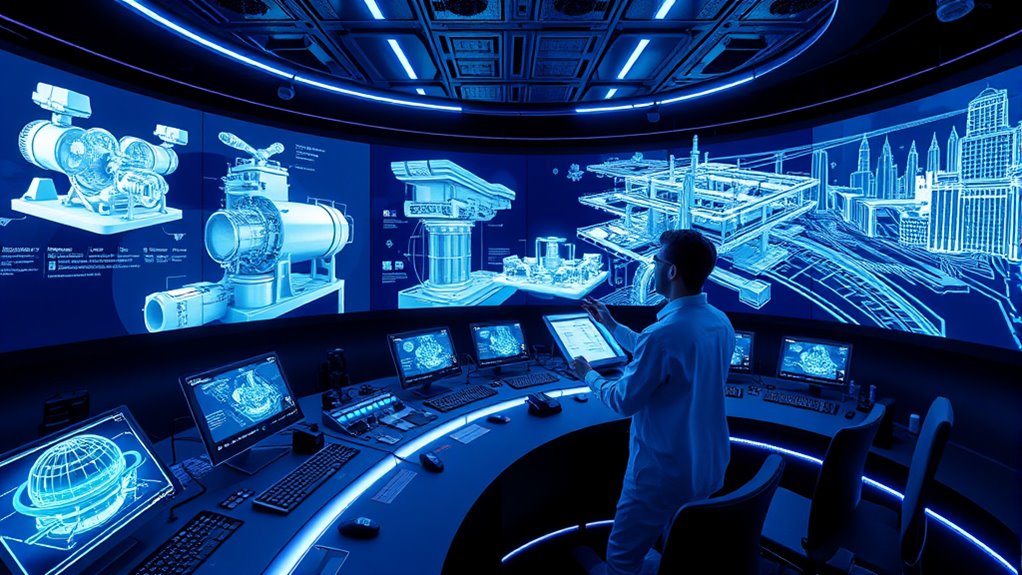
Across various sectors, digital twins are transforming how organizations monitor, optimize, and innovate their operations. You can now:
- Prevent costly equipment failures in aerospace by predicting issues before they happen, safeguarding safety and reducing downtime.
- Design smarter cities by simulating traffic flow and energy consumption, creating more efficient and sustainable urban environments.
- Personalize healthcare with patient-specific organ models that enhance treatment accuracy and outcomes.
- Incorporate natural techniques in agriculture to improve sustainability and productivity, demonstrating the versatility of digital twin technology beyond traditional industries.
These applications empower you to make faster, data-driven decisions, improve safety, and reduce costs. Digital twins enable continuous testing and refinement without physical risks, giving you a competitive edge. As industries adopt these virtual models, they *liberate* new levels of operational excellence and innovation, transforming traditional practices into smarter, more responsive systems.
Key Benefits and Value Drivers of Digital Twin Adoption

Adopting digital twins releases significant benefits by enabling real-time monitoring, predictive maintenance, and data-driven decision-making. You gain immediate visibility into asset performance, allowing rapid responses to issues before they escalate. Predictive analytics help you forecast failures, reducing downtime and maintenance costs. This proactive approach enhances safety and operational efficiency. Digital twins also streamline product development and deployment by simulating scenarios virtually, cutting time-to-market. Decision-making becomes more accurate with exhaustive, synchronized data from physical systems. Additionally, resource optimization through AI-driven insights helps you allocate assets efficiently and reduce waste. Interestingly, the growing adoption of digital twins reflects the increasing importance of resources and tools in optimizing operations. Overall, implementing digital twins boosts productivity, minimizes risk, and supports continuous improvement, delivering measurable value across your organization.
Technological Foundations and Future Trends in Digital Twin Systems

Have you ever wondered what powers the advanced capabilities of digital twin systems? It’s the fusion of cutting-edge technologies that shape their future. First, AI and machine learning enable autonomous decision-making and predictive insights, transforming digital twins into proactive tools. Second, cloud and edge computing provide scalable, real-time data processing, ensuring seamless virtual-physical interaction. Third, advanced physics-based modeling and domain expertise improve accuracy, simulating complex behaviors for better predictions. Future trends include generative AI for modeling intricate system behaviors and autonomous optimization to streamline operations. As these innovations converge, digital twins will become more intelligent, responsive, and capable of supporting smarter cities, industries, and healthcare—revolutionizing how you monitor, control, and optimize physical systems in real-time.
Frequently Asked Questions
How Do Digital Twins Ensure Data Security and Privacy?
You guarantee data security and privacy in digital twins by implementing strong encryption methods for data transmission and storage, preventing unauthorized access. You also use secure authentication protocols and access controls to restrict data to authorized users. Regular security audits and monitoring help detect vulnerabilities early. Additionally, you anonymize sensitive data and comply with privacy regulations to protect user information throughout the digital twin ecosystem.
What Challenges Exist in Integrating Digital Twins With Legacy Systems?
You know what they say, “Old habits die hard.” Integrating digital twins with legacy systems can be tricky because these systems often lack compatibility with modern data protocols and security standards. You might face issues like data silos, outdated infrastructure, and limited real-time data exchange. To succeed, you’ll need to update or bridge these systems with middleware, ensuring seamless communication while safeguarding data integrity and security.
How Accurate Are Digital Twins in Predicting Real-World Outcomes?
You can expect digital twins to be quite accurate in predicting real-world outcomes, especially when they’re built with high-quality data and advanced modeling techniques. They continuously learn from real-time and historical data, which improves their precision over time. However, their accuracy depends on the complexity of the system and data integrity. When well-designed, digital twins provide reliable insights, enabling you to make informed decisions and optimize performance effectively.
What Skills Are Necessary to Develop and Maintain Digital Twin Systems?
You need a mix of technical and analytical skills to develop and maintain digital twin systems. Strong knowledge of data science, programming, and sensor technology is essential, along with expertise in IT, OT, and engineering domains. You should also be comfortable working with cloud platforms, AI tools, and physics-based modeling. Critical thinking, problem-solving, and the ability to interpret complex data help guarantee the system’s accuracy and ongoing performance.
How Do Digital Twins Impact Environmental Sustainability and Resource Use?
Ever imagine how you could reduce waste and conserve resources? Digital twins help you do just that by optimizing energy use, predicting equipment failures, and streamlining operations. With real-time data, you can identify inefficiencies early, minimize environmental impact, and promote sustainability. They encourage smarter decisions, lower emissions, and better resource management. Isn’t it time you harness digital twins to create a greener, more efficient future for your projects and communities?
Conclusion
As you explore digital twins, consider whether they truly revolutionize industry or simply mimic real-world systems. While many believe they gain access to unmatched efficiencies, some argue they may overpromise benefits without delivering consistent results. By investigating this theory, you’ll understand whether digital twins are the future or just a sophisticated illusion. Embrace this technology thoughtfully, questioning its potential and limitations to truly harness its transformative power in your field.
Fall Picks
fall essentials
As an affiliate, we earn on qualifying purchases.