
Edge computing moves data processing closer to your IoT devices, enabling faster responses and reducing latency. It helps optimize network bandwidth by filtering and analyzing data locally, which lowers operational costs and improves scalability. It also enhances security by limiting data transmission over networks. Plus, it guarantees system reliability, even in remote or critical environments. Exploring these benefits reveals how edge computing can transform your IoT applications and performance.
Key Takeaways
- Edge computing enables real-time data processing directly at IoT device locations, reducing latency and response times.
- It minimizes network congestion by filtering and aggregating data locally before transmitting to the cloud.
- Local data handling enhances security by limiting sensitive information exposure during transmission.
- Edge devices support autonomous decision-making, ensuring system operations continue during connectivity disruptions.
- Integration with 5G and AI advances boosts processing power, enabling smarter and more efficient IoT deployments at the network’s edge.
Enhancing Response Times With Local Data Processing
Local data processing considerably improves response times in IoT applications by handling information directly at the edge. When you process data close to where it’s generated, you eliminate the delays caused by transmitting information to distant data centers. This means systems can react almost instantly to sensor inputs, which is essential for time-sensitive tasks like industrial automation or autonomous navigation. Edge computing enables real-time analytics, so you don’t have to wait for cloud processing to make decisions. As a result, critical operations such as fault detection, safety alerts, or machinery adjustments occur without delay. This quick response capability not only enhances operational efficiency but also guarantees safety and reliability in environments where every millisecond counts. Additionally, understanding projector technology helps optimize system performance for various applications.
Optimizing Network Bandwidth for Scalable IoT Deployment
To scale your IoT deployment effectively, you need to optimize how data moves across the network. Local data filtering helps reduce unnecessary transmissions, ensuring only essential information reaches central systems. By making data transmission more bandwidth-efficient, you can prevent network congestion and lower operational costs. Utilizing smart capabilities in devices allows for better management and filtering of data at the source, further enhancing network efficiency.
Local Data Filtering
Ever wonder how IoT networks manage to handle vast amounts of data without becoming overwhelmed? The key is local data filtering. Instead of sending every raw data point to the cloud, your edge devices analyze and process data on-site. They identify which information is critical and discard or summarize less important details. This approach reduces the volume of data transmitted over the network, conserving bandwidth and lowering costs. By filtering data locally, you prevent network congestion, especially in dense deployments like factories or smart cities. It also ensures that only relevant, actionable insights reach central servers, enhancing overall efficiency. Local data filtering simplifies scaling IoT systems, improves responsiveness, and maintains performance even as device counts grow exponentially. Utilizing the appropriate tea kettle material can help ensure optimal temperature control for sensitive data processing tasks.
Bandwidth-efficient Data Transmission
Optimizing network bandwidth is essential for supporting the rapid growth of IoT deployments, especially as millions of devices generate vast amounts of data. To achieve this, you should process data locally at the edge, sending only essential summaries or alerts to central systems. This approach prevents network congestion and reduces operational costs. Use data compression and event-driven transmission to guarantee that only meaningful information consumes bandwidth. Prioritize transmitting critical data while filtering out noise or redundant information. Implement protocols designed for low bandwidth environments, like MQTT or CoAP, to enhance efficiency. By managing data flow intelligently, you maintain system responsiveness and scalability, ensuring your IoT infrastructure can grow without overwhelming network resources or incurring unnecessary expenses.
Strengthening Security Through Distributed Edge Solutions
You can strengthen your security by processing data locally at the edge, which reduces the risk of cyber threats traveling over public networks. Decentralized data protection guarantees that breaches in one area don’t compromise your entire system. Implementing real-time threat detection at the edge keeps your infrastructure more resilient and responsive to security incidents. Additionally, incorporating entertainment ideas can make security training sessions more engaging for staff, fostering better awareness and vigilance.
Local Threat Detection
Local threat detection leverages distributed edge solutions to enhance cybersecurity by enabling real-time monitoring and rapid response directly at the data source. By analyzing data locally, you can identify suspicious activities or anomalies instantly, reducing the time between detection and action. This proactive approach limits the spread of cyber threats before they escalate, preventing potential breaches or operational disruptions. Edge devices can run threat detection algorithms tailored to specific environments, ensuring relevant and immediate insights. additionally, local detection minimizes the need to transmit sensitive data over networks, decreasing exposure to interception or tampering. With this setup, you boost your security posture by addressing threats at their origin, maintaining operational continuity, and safeguarding your infrastructure more effectively. Continuous monitoring of AI behavior is also critical to adapt to evolving threats and vulnerabilities in real-time.
Decentralized Data Protection
How does distributing data protection across edge devices enhance your overall security? By decentralizing security measures, you reduce the risk of a single point of failure. Each edge device manages its own encryption, authentication, and access controls, making it harder for cybercriminals to compromise your entire system. Localized data protection means sensitive information stays close to where it’s generated, minimizing exposure during transmission. This setup allows for rapid threat detection and response directly at the device level, preventing breaches from spreading. Additionally, distributed security solutions enable compliance with privacy laws by keeping data within specific regions. Active listening and empathy are also critical in understanding and responding to security threats effectively. Overall, decentralizing data protection creates a resilient, layered defense, safeguarding your network even if one node is compromised. It’s a proactive approach that strengthens your security posture at every point in the edge ecosystem.
Ensuring System Reliability in Remote and Critical Environments

Ensuring system reliability in remote and critical environments requires robust edge computing solutions that can operate independently when connectivity is limited or disrupted. You need systems that remain functional without constant cloud access, minimizing downtime and maintaining safety. To achieve this, consider:
- Deploying autonomous edge devices with local decision-making capabilities, so critical functions continue uninterrupted during outages.
- Implementing fault-tolerant architectures that include redundant hardware and data replication across multiple edge nodes.
- Regularly testing and updating firmware to ensure resilience against failures and cyber threats, especially in harsh or inaccessible locations.
- Monitoring for signs of spoiled data, such as corruption or unauthorized access, to maintain system integrity and reliability.
Boosting Operational Efficiency via Pre-Processing at the Edge
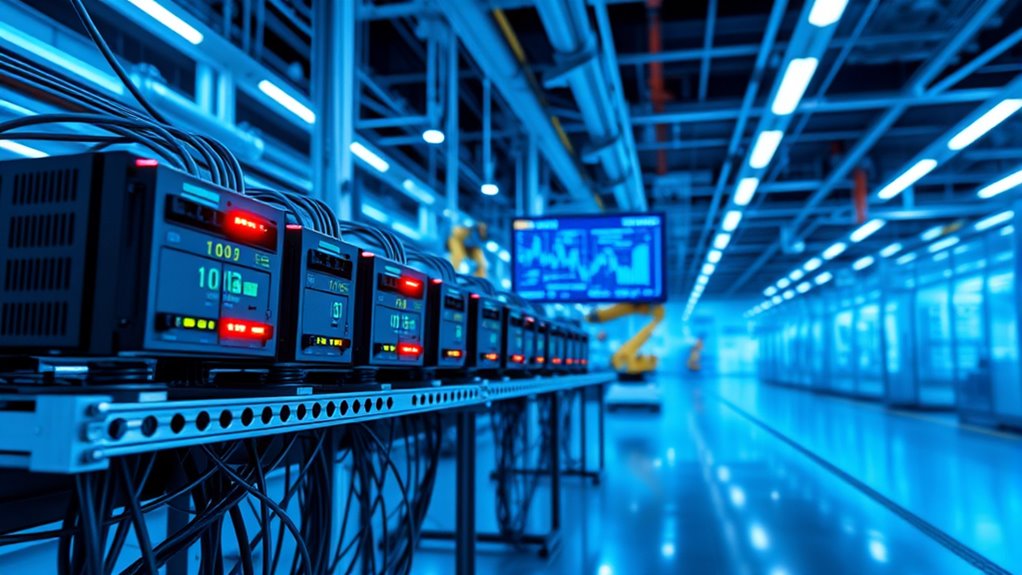
Pre-processing data at the edge considerably boosts operational efficiency by reducing the volume of raw information sent to the cloud. You can filter, aggregate, and analyze data locally, which minimizes bandwidth use and lowers cloud storage costs. This process enables faster decision-making, as critical insights are generated instantly without waiting for cloud processing. By handling routine or low-value data on-site, you free up cloud resources for more complex computations. Pre-processing also decreases latency, allowing real-time responses for applications like predictive maintenance or safety monitoring. Additionally, understanding regional legal resources can facilitate compliance and smooth operation. Overall, it simplifies data management, reduces operational expenses, and enhances system responsiveness. This approach ensures your IoT deployment is more scalable, efficient, and capable of delivering timely, actionable insights at the network’s edge.
Real-World Applications of Edge-Enabled IoT Systems

Edge-enabled IoT systems are transforming industries by providing real-time insights and control directly at the source of data. This allows you to make instant decisions, improve safety, and boost efficiency. For example, in manufacturing, edge devices monitor machinery in real-time, reducing downtime. In smart cities, traffic lights and cameras process data locally to ease congestion and respond quickly to incidents. In transportation, autonomous vehicles rely on on-board edge computing for rapid sensor analysis, enabling safe navigation without cloud delays. Additionally, selecting appropriate hardware and software is crucial to maximize system performance and reliability.
Edge IoT systems enable instant decisions and enhanced safety through local data processing across industries.
Here are three key applications:
- Real-time factory monitoring for predictive maintenance
- Localized traffic management and incident detection
- On-board sensor processing for autonomous vehicle safety
Future Trends in Edge Computing and IoT Integration
As IoT continues to expand across industries, the integration of edge computing is poised to become even more sophisticated with advancements in AI, 5G, and hardware design. Future trends include smarter edge devices capable of autonomous decision-making, further reducing latency. 5G’s high-speed connectivity will enable real-time data processing at unprecedented scales. Additionally, hardware innovations will make edge devices more energy-efficient and capable of handling complex AI models locally. To illustrate, consider this comparison:
| Trend | Impact |
|---|---|
| AI at the Edge | Enhanced autonomous operation and analytics |
| 5G Integration | Near-instant data transfer and response |
| Advanced Hardware | More powerful, energy-efficient edge devices |
| Distributed AI | Collaborative decision-making across multiple nodes |
| Security Enhancements | Improved safety through localized threat detection |
These trends will drive the next wave of IoT innovation at the network’s edge. Understanding the importance of edge computing] can help in recognizing how these advancements will shape future technology landscapes.
Frequently Asked Questions
How Does Edge Computing Impact Overall Iot Cost Management?
Edge computing helps you lower overall IoT costs by reducing data transfer and cloud storage needs. You process data locally, which cuts bandwidth expenses and minimizes cloud computing charges. Plus, it boosts system efficiency, enabling faster decision-making and reducing downtime. With autonomous operations during outages, you avoid costly disruptions. Overall, edge computing streamlines your IoT operations, saving money while improving reliability and real-time responsiveness.
What Are the Main Challenges in Deploying Large-Scale Edge Iot Solutions?
You face challenges like managing complex infrastructure, ensuring seamless connectivity, and maintaining security across numerous edge devices. Deploying large-scale solutions requires coordinating hardware, software, and network compatibility while preventing data inconsistencies. You also need to address scalability issues, handle remote device maintenance, and guarantee real-time performance. Overcoming these hurdles involves strategic planning, robust security measures, and reliable management tools to assure your edge IoT system functions smoothly and efficiently.
How Does Edge Computing Facilitate Compliance With Data Privacy Laws?
You can meet data privacy laws more easily with edge computing by processing sensitive data locally, eliminating the need to transmit it over public networks. This keeps private information within designated boundaries, reducing exposure risks. You also gain control over data residency, ensuring compliance with regional regulations. By limiting data movement and implementing local security measures, you strengthen privacy protections and reduce the chances of breaches, making your IoT solutions more compliant and secure.
What Hardware Considerations Are Essential for Effective Edge Iot Devices?
You need durable, energy-efficient hardware with robust processing power, like embedded CPUs or GPUs, to handle real-time data. Guarantee your devices have reliable connectivity options, such as LTE or Wi-Fi, for seamless communication. Incorporate secure storage and hardware security modules to protect sensitive data. Opt for scalable, modular designs that allow upgrades, and select rugged enclosures suited for your environment, whether industrial, outdoor, or remote.
How Is Artificial Intelligence Integrated Into Edge Iot Systems?
Think of AI as your trusty sidekick in edge IoT systems, helping you make smarter decisions locally. You integrate AI by deploying lightweight models directly onto edge devices, enabling real-time data analysis without cloud delays. Use optimized algorithms for low-power processors, and guarantee your devices can handle AI workloads efficiently. This setup allows instant insights, improved security, and autonomous actions—just like having your own mini AI-powered control center right at the edge.
Conclusion
By 2025, over 75 billion IoT devices will generate vast amounts of data at the network’s edge, transforming how you process information. Embracing edge computing lets you improve response times, save bandwidth, and enhance security—all while ensuring your systems stay reliable in any environment. As you adopt these solutions, you’ll be at the forefront of a smarter, more efficient IoT landscape, ready to meet future challenges with confidence.