Compact camping tents are compared for a reason: a smaller shelter is easier to carry and store, but compactness can come with tradeoffs in price, room, weather protection, or durability. The key decision is whether you need to carry the tent on your back or simply want one that takes up less room in a car, closet, or campsite.

Get travel and outdoor gear delivered free with Prime
- Fast, free delivery on millions of items
- Prime Video, Amazon Music and more included
- Member-only deals all year

Night Cat Lightweight Waterproof Backpacking Tent for 1–2 People
- ✔ Occupancy: 1 person; can accommodate 1 adult and 1 child
- ✔ Floor dimensions: 2.2 × 1.2 m
- ✔ Maximum height: 1.2 m

Night Cat Compact Backpacking Tent, 1 Person
- ✔ Occupancy: 1 adult; can fit 1 child if needed
- ✔ Season: 3 season
- ✔ Dimensions: 83 × 45 × 45 in
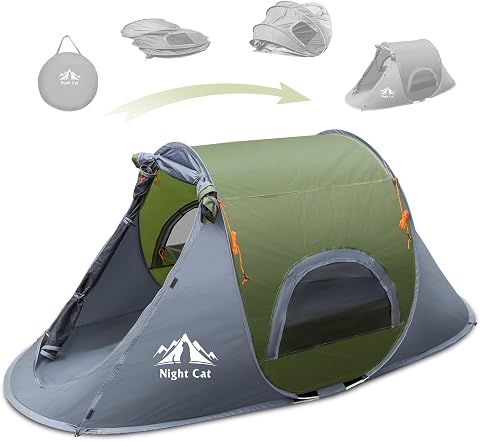
Night Cat 1-Person Pop-Up Camping Tent
- ✔ Occupancy: 1 person
- ✔ Season: 3 season
- ✔ Inner dimensions: 7.7 × 3.3 × 2.95 ft
This comparison looks at two broad types rather than specific models. An ultralight compact camping tent is designed to reduce carried weight and packed size, typically using lighter materials and a more weight-conscious design. A budget compact camping tent prioritizes a lower purchase price and straightforward camping use; it may be compact enough for travel, but is not usually optimized for long walks with a full pack. Choose the ultralight type if every carried gram matters. Choose the budget type if you camp near your vehicle, go out occasionally, or would rather spend less than pay for weight savings.
At a Glance
| Criteria | Ultralight compact camping tent | Budget compact camping tent | Winner |
|---|---|---|---|
| Carried weight | Usually lighter, with weight-saving materials and a design aimed at carrying on foot. | Usually heavier; the extra load matters less when you transport the tent by car. | A |
| Packed size | Usually packs smaller, though the exact packed volume depends on the model and included components. | Can be compact enough for a trunk or cupboard, but may take up more pack space. | A |
| Purchase cost | Often costs more because lightweight materials and specialized construction raise the price. | Usually less expensive and more accessible for occasional use. | B |
| Interior comfort | May trade some interior space, headroom, or storage for a lower carried weight. | May offer more room for the money, depending on the design and capacity. | Depends |
| Weather protection | Can provide reliable protection, but performance varies; light materials need careful handling. | Protection varies by model; check its rainfly, floor, seams, and ventilation rather than relying on price. | Depends |
| Durability and repair | Materials can be more vulnerable to abrasion, and repairs or replacement parts may be specialized. | Can be a practical choice for casual use, though inexpensive fabrics and components also require care. | Depends |
| Setup and versatility | Often requires careful setup and can suit backpacking, bikepacking, or other weight-sensitive trips. | Often straightforward for campground use and a sensible fit when one tent must serve occasional trips. | Depends |
Night Cat Lightweight Waterproof Backpacking Tent for 1–2 People
This is our best-balanced choice for solo campers who want a backpacking tent with a clear weather-protection specification. At 1.97 kg and 42 × 12 × 12 cm packed, it is the lightest of the three by a small margin, and its stated 3000 mm water resistance with taped seams matches the Compact Backpacking Tent. The pop-up is lighter still at 1.5 kg, but lists a lower 2000 mm rating, so buyers prioritizing that specification may prefer this dome.Ventilation comes from a mesh door and roof window, a useful pairing for airflow while helping keep bugs out. Its 2.2 × 1.2 m floor is best understood as a solo footprint: the description allows an adult and child, but that is a tight fallback rather than comfortable two-person accommodation. The 1.2 m maximum height also makes this a sit-up-and-sleep shelter, not a place to stand or move around freely.The main compromise is the pitch. Its fiberglass poles must be manually fed through diagonal sleeves, which is more involved than the clip-on setup of the second tent and less immediate than the pop-up. Choose this one when the balanced weight and water-resistance details matter more than shaving setup steps; skip it if quick assembly or shared adult space is the priority.
Pros:
- At 1.97 kg, it is the lightest of the two 3000 mm backpacking domes.
- Rainfly has a stated 3000 mm water-resistance rating and taped seams.
- Mesh door and roof window support ventilation.
- Pole covers are intended to make fiberglass pole handling safer.
Cons:
- Manual pole threading through diagonal sleeves takes more effort than the clip-on alternative.
- The one-person floor leaves limited room for an adult and child together.
- At 1.2 m high, it offers little room to sit upright comfortably.
Best for: Solo backpackers who want a light dome tent with a 3000 mm water-resistance rating and ventilation openings.
Not ideal for: Two adults, campers who want a fast clip-on pitch, or anyone seeking enough headroom to stand.
Bottom line: We recommend it as the most balanced compact option for solo trips where stated rain protection and low weight matter more than the fastest pitch.
“We recommend it as the most balanced compact option for solo trips where stated rain protection and low weight matter more than the fastest pitch.”
Night Cat Compact Backpacking Tent, 1 Person
For campers who would rather clip a tent body onto poles than thread sleeves, this model has the most persuasive setup advantage in the lineup. Its clip-on pole attachment simplifies assembly compared with the diagonal sleeves on the Lightweight Waterproof Backpacking Tent. That does not make it a pop-up: poles still need to be assembled, but the attachment method should make the steps more straightforward to follow.Its weather details are on par with the top-ranked dome: PU 3000 coating and taped seams. It also adds a small vestibule, giving muddy footwear or a small amount of gear a place outside the sleeping area. The supplied dimensions list 83 × 45 × 45 inches, though the product information does not clarify which dimension corresponds to height, so we would not use those figures alone to infer interior comfort. Like the other tents, it sleeps one adult and only mentions a child as an occasional additional occupant.At 2 kg, it is just slightly heavier than our overall pick, while its packed length is 16.5 inches. The pop-up packs flatter, but it is heavier in stated metric weight and has a lower water-resistance rating. Buyers should also factor in fiberglass poles, which may not suit those seeking the durability associated with metal poles. This is the sensible choice when an easier-to-understand pitch and vestibule matter more than the smallest weight difference.
Pros:
- Clip-on pole attachment avoids threading long sleeves.
- PU 3000 coating and taped seams match the top pick’s stated water-resistance level.
- Includes a small vestibule, two guylines, and stakes.
- Mesh door and roof window provide ventilation.
Cons:
- At 2 kg, it is slightly heavier than the top-ranked backpacking tent.
- Fiberglass poles may be less durable than metal alternatives.
- The listed dimensions do not clearly identify the interior height.
Best for: Solo backpackers who prefer clip-on pole attachment and want a small vestibule for gear or footwear.
Not ideal for: Campers seeking the lowest stated weight, a flat-packed pop-up form, or metal poles.
Bottom line: We would choose this over the overall pick when clip-on assembly and a vestibule are more useful than a marginally lower carry weight.
“We would choose this over the overall pick when clip-on assembly and a vestibule are more useful than a marginally lower carry weight.”
Night Cat 1-Person Pop-Up Camping Tent
When getting shelter up quickly is the deciding factor, the pop-up design gives this tent a role the two domes cannot match. It opens in about three seconds, according to the supplied description, and its 21 × 21 × 2 in package is broad and flat rather than a narrow pole-style bundle. That shape may fit more easily in a car or against a pack than a long cylindrical tent sack, but it still takes up a substantial square footprint.The stated weight is 1.5 kg (3.3 lb), lighter than either backpacking dome. However, weather protection is rated at 2000 mm, below the 3000 mm ratings specified for both dome tents. Taped seams and a polyurethane-coated polyester fabric are listed, but buyers expecting the higher stated rating of the other two should choose one of them instead. Two windows and a door offer ventilation; the door can also form a porch if trekking poles or suitable sticks are supplied separately.The largest practical catch is pack-down. A tent that opens quickly is only convenient if we can fold it reliably at the end of the trip, and the product description says folding takes practice. Its 7.7 × 3.3 ft inner dimensions are for one person, while the porch poles are not included. We rank it third because speed and low weight are compelling, but its lower water-resistance rating and more demanding repacking make it less versatile than the backpacking tents.
Pros:
- Pop-up design opens rapidly, reducing setup time at camp.
- At 1.5 kg, it is the lightest of the three by stated weight.
- Two windows and a door give it multiple ventilation openings.
- Door can form a porch when trekking poles or sticks are available.
Cons:
- Its 2000 mm water-resistance rating is lower than the 3000 mm ratings of both domes.
- Folding the tent back into its package takes practice.
- The porch requires trekking poles or sticks that are not included.
Best for: Solo campers who value an almost immediate pitch and want a lightweight tent with a flat package.
Not ideal for: Backpackers who need a narrow packed bundle, campers who prioritize the highest listed water resistance, or anyone unwilling to practice folding.
Bottom line: We recommend it for quick-pitch solo outings where low weight beats a higher water-resistance rating and easy pack-down.
“We recommend it for quick-pitch solo outings where low weight beats a higher water-resistance rating and easy pack-down.”
As an Amazon Associate we earn from qualifying purchases.
Key Differences
The clearest advantage of an ultralight compact tent is on the trail. Lower weight and less pack volume reduce the burden over a long walk and leave more room for food, water, and other gear. That advantage is real, but it matters most when you carry the tent for a meaningful distance. For car camping, a heavier shelter can be easy to live with, and weight savings may not justify paying a premium.
The budget type usually wins on purchase price and can provide a more sensible entry point for occasional camping. Yet lower cost alone does not establish good value: check the actual packed dimensions, capacity, rain protection, ventilation, and stated materials. An inexpensive tent that is awkward to carry or poorly suited to local conditions may be a false saving. Conversely, paying extra for a lighter tent does not automatically buy more room or better weather protection.
Neither category guarantees comfort, durability, or dependable performance in bad weather. Those depend on the individual tent’s shape, construction, materials, and care. Treat capacity labels as a starting point, check whether the footprint and poles are included in listed packed weight, and read the setup and weather guidance. The best choice follows your trips: frequent walking favors the ultralight type; infrequent, vehicle-access camping favors the budget type.
Detailed Comparison
Carried weight (Ultralight compact camping tent wins — major)
The ultralight compact tent wins by a major margin for trips where you carry your shelter. Its design is intended to reduce load, while a budget tent may use heavier fabrics, poles, or fittings to keep the purchase price down. On a short walk from a parking area, the difference may barely affect the day. Over several days of hiking, every extra item adds to the load you carry mile after mile, so the lighter tent can make packing and walking more comfortable. Compare the complete packed weight, including poles, stakes, and any required footprint, rather than a headline weight that excludes essentials.
Packed size (Ultralight compact camping tent wins — moderate)
The ultralight type usually wins, with a moderate practical advantage. It is generally built to take up less space in a backpack, where a bulky tent competes with food, clothing, and safety gear. A budget model can still be compact enough for a car trunk or home storage, but that does not mean it packs conveniently inside a hiking pack. For vehicle camping, packed volume is usually a storage detail; for backpacking, a smaller bundle can make it easier to organize the load. Check packed dimensions as well as weight, since narrow or long bundles may fit awkwardly even when their volume seems low.
Purchase cost (Budget compact camping tent wins — major)
The budget tent wins by a major margin on upfront cost. It is the more accessible choice if you are trying camping for the first time, go out only a few weekends each year, or need to outfit more than one person without spending heavily on each item. The extra expense of an ultralight model buys a specialized benefit: carrying less weight and often packing smaller. If the tent travels from the car to a nearby pitch, that benefit may be too small to notice. If you routinely hike with it, the premium can be worthwhile because it improves a part of the trip you repeat every day.
Interior comfort (moderate difference)
This is a model-by-model decision, so neither type wins across the board. A lighter design may save weight through a narrower floor, lower ceiling, or less room for gear, but some ultralight tents provide good livability for their intended capacity. Budget tents may offer more room for the price, though their shape and usable floor area vary widely. Check the interior dimensions, peak height, door arrangement, and space for wet or dirty equipment. If you spend long evenings inside because of rain, usable room can matter more than a modest reduction in packed weight. Do not assume that a two-person label means two adults will have comfortable space plus their packs.
Weather protection (major difference)
There is no reliable category-wide winner; the difference is potentially major for the trip. A tent’s ability to handle rain and wind depends on its design and construction, not simply whether it is ultralight or budget. Examine how much of the tent the rainfly covers, how the floor is protected, how seams are constructed, and whether the design can be pitched securely in exposed conditions. Ventilation also matters: poor airflow can leave condensation inside even when rain stays out. A lighter tent may use thinner materials that call for more careful pitching, while a low-cost tent may have limitations in its fly or fittings. Match the specific model to the weather you expect, and follow its guidance on conditions.
Durability and repair (moderate difference)
Neither category guarantees longer life; compare the materials and available repair options. Ultralight tents often use lighter fabrics, which can be more vulnerable to punctures, rough ground, and abrasion if handled carelessly. That does not make them automatically fragile, but it does make campsite selection and careful packing more important. Budget tents may use sturdier-feeling or simpler components, yet a low price can also mean less robust fabrics, zippers, or poles. Inspect the stress points and find out whether replacement poles or repair materials are available. For frequent use on rough ground, an easily maintained shelter may be better value than chasing the lowest weight or price.
Setup and versatility (minor difference)
For casual campground use, the budget type often has a moderate advantage in convenience; for weight-sensitive travel, the ultralight type can be more versatile. A straightforward design may be easier for a new camper to pitch, but setup depends on the specific pole system and instructions. Some ultralight tents ask for more care with tension, stakes, or site choice, while others are simple to pitch. They can suit trips where carried weight matters, such as backpacking or bikepacking. A budget model is more likely to be a practical general-purpose purchase for weekends near a vehicle. Before buying, check whether poles, stakes, and any footprint are included, and practice pitching at home.
Ultralight compact camping tent: Pros and Cons
Pros:
- Lower carried weight can make backpacking more comfortable.
- Smaller packed size leaves more room for other gear.
- A strong fit for frequent trips where the shelter is carried for hours.
Cons:
- Usually costs more than a budget compact tent.
- Lighter materials may require more careful handling.
- Weight savings may have little practical value at a drive-up campsite.
Budget compact camping tent: Pros and Cons
Pros:
- Lower upfront price suits occasional camping and tighter budgets.
- Can be an uncomplicated choice for car camping and nearby pitches.
- May provide useful interior space for the price, depending on the model.
Cons:
- Often heavier and bulkier to carry on foot.
- A compact label does not guarantee a backpack-friendly packed size.
- Weather protection, materials, and available repairs vary by model.
Who Should Choose What
Choose Ultralight compact camping tent if:
- You hike to camp and carry the tent for several miles or multiple days.
- Your pack has limited room and you are willing to pay to reduce weight and packed size.
- You camp often enough that a lighter shelter improves many trips, not just one.
Choose Budget compact camping tent if:
- You camp near your vehicle and do not need to carry the tent far.
- You camp occasionally or are buying your first shelter at a lower cost.
- You value a practical general-purpose tent more than reducing every gram in your pack.
Skip both if: Neither type fits if you need a tent for sustained severe weather, unusually tall occupants, or a larger group and cannot confirm that a specific model meets those needs. Look for a shelter designed and rated for the conditions, capacity, and comfort you require.
Value for Money
The budget compact tent is better value for occasional car campers because it avoids paying for weight savings they may never use. That does not mean choosing the cheapest listing: a tent still needs suitable rain protection, enough room, and components that match how often and where you camp. Check the full packed weight and dimensions, stated capacity, included parts, and repair options before comparing prices.
Pay more for the ultralight type when you regularly carry your shelter on foot and the reduced load will improve repeated trips. For that buyer, a higher purchase price can be justified by a benefit felt on every hiking day. If you only walk a short distance from the car, the premium is harder to justify; spend it only if the specific tent also offers a feature you need, such as suitable room or a better-matched design. Value comes from fit with your trips, not the category name.
Final Verdict
Choose an ultralight compact camping tent if you backpack regularly and want less weight and bulk in the load you carry. Its advantage is clearest over long distances and repeated trips, where reduced pack burden matters day after day. Choose a budget compact camping tent if you camp near your vehicle, go out occasionally, or need to keep the initial cost down. For most casual campers, the budget option is the better value; for frequent backpackers, paying more for a genuinely lighter, smaller model is often the better decision.
The deciding factor is how far you carry the tent. After that, compare the actual model’s interior dimensions, complete packed weight, weather protection, and repair options. Skip either category if its stated capacity or conditions do not match your trip. A well-suited shelter matters more than a low scale reading or a low price on its own.
Frequently Asked Questions
Are compact camping tents suitable for backpacking?
Some are. Check the complete packed weight and dimensions, including poles and stakes, and confirm that the tent’s capacity and weather protection suit your route. A tent described as compact may still be too heavy or bulky for comfortable backpacking.
Is an ultralight compact tent worth the higher price?
It can be worth the extra cost if you carry the shelter often and the lower weight improves repeated hikes. For car camping or occasional trips, the weight savings may not matter enough to justify the premium. Compare the specific tent’s room, protection, and included components before deciding.
Does a budget compact tent protect against rain?
Price alone does not answer that. Check the model’s rainfly coverage, floor, seams, and guidance for use in wet or windy conditions. Set it up as directed, and avoid assuming that every compact tent can handle the same weather.
How much room should I expect in a two-person tent?
Capacity labels are not a promise of roomy sleeping space. Compare floor dimensions and peak height, then account for whether packs or other gear need to stay inside. If you want more comfort or spend time inside during bad weather, a larger capacity may suit you better.