Among these travel camera bags, I’d choose the K&F CONCEPT Lightweight Camera Backpack with Tripod Holder as the best overall starting point for trips that call for comfortable carrying and room for camera essentials. The K&F CONCEPT 30L Camera Backpack suits travelers carrying a larger kit, while the K&F Concept 2-in-1 Camera Sling Bag offers quicker access in a smaller format. The main tradeoff is between capacity and carrying comfort, quick access and all-day support, or extra protection and added bulk. A bag that fits a camera body at home may feel cramped once you add a laptop, tripod, or personal items. Read on for the full breakdown and a guide to choosing the right style for your travel setup.

Get travel and outdoor gear delivered free with Prime
- Fast, free delivery on millions of items
- Prime Video, Amazon Music and more included
- Member-only deals all year
Complete the kit


Key Takeaways
- The lineup rewards matching bag style to trip length: the 30L backpack is the clearest fit for a larger camera kit, while sling and crossbody styles suit lighter everyday carry.
- Quick access and load support pull in different directions: sling bags make gear easier to reach, while backpacks are better suited to carrying heavier loads across a full travel day.
- Weather protection varies by design: models advertised with waterproof construction or a rain cover offer a different layer of protection than bags whose main appeal is compactness or vintage styling.
- Travel extras change the bag’s role: laptop compartments, tripod holders, and rolling capability matter when they match the itinerary, but can add bulk or complexity when they do not.
- There is no single best shape for every traveler: the strongest choice depends on what you carry, how often you need to access it, and whether you prioritize protection, capacity, or a low-profile profile.
| RAINSMORE Vintage Camera Bag with Side Access for DSLR/SLR Mirrorless |  | Best for Organized Day Trips | Capacity: 25 liters | Dimensions: 13.3 × 6 × 17.3 inches | Weight: 1.55 kg | VIEW LATEST PRICE | See Our Full Breakdown |
| K&F CONCEPT 30L Camera Backpack for Photographers |  | Best for Larger Travel Kits | Capacity: 30 liters | External dimensions: 11.42 × 8.66 × 21.26 inches | Internal dimensions: 10.63 × 6.1 × 20.87 inches | VIEW LATEST PRICE | See Our Full Breakdown |
| K&F Concept 2-in-1 Camera Sling Bag |  | Best Compact Sling for Flexible Kits | Capacity: 10 liters | External dimensions: 13 × 8.6 × 5.9 inches | Internal dimensions: 10.6 × 6.7 × 4.1 inches | VIEW LATEST PRICE | See Our Full Breakdown |
| CADeN Camera Backpack for DSLR, SLR, and Mirrorless Cameras |  | Best Lightweight Budget-Style Backpack | Capacity: 17 liters | Dimensions: 11 × 5.9 × 15 inches | Weight: 1.7 pounds | VIEW LATEST PRICE | See Our Full Breakdown |
| NEEWER Convertible Rolling Camera Backpack |  | Best for Airport Transfers with Heavy Gear | Capacity: 50 liters | Dimensions: 22 × 14 × 10 inches | Weight: 4.15 kg | VIEW LATEST PRICE | See Our Full Breakdown |
| RAINSMORE Waterproof Camera Backpack with Rain Cover, 15.6-Inch Laptop Compartment |  | Best for All-Weather Gear Hauls | Storage volume: 28 liters | Dimensions: 17.7 × 7.87 × 12.79 inches | Weight: 1.65 kg | VIEW LATEST PRICE | See Our Full Breakdown |
| MOSISO Camera Backpack for DSLR, SLR, and Mirrorless Cameras |  | Best for Organized Carry-On Kits | Storage volume: 35 liters | Dimensions: 17.32 × 11.8 × 7.5 inches | Weight: 3.2 pounds | VIEW LATEST PRICE | See Our Full Breakdown |
| MOSISO Camera Sling Bag for DSLR, SLR, and Mirrorless Cameras |  | Best Compact Sling for Quick Access | Dimensions: 15.7 × 9.06 × 4.8 inches | Lower compartment inner dimensions: 10.1 × 7.87 × 4.33 inches | Weight: 8 ounces | VIEW LATEST PRICE | See Our Full Breakdown |
| TAAOKA Waterproof Camera Sling Bag with Tripod Holder, Black |  | Best Weather-Ready Everyday Sling | Dimensions: 12.6 × 5.5 × 7.8 inches | Capacity: 563.29 cubic inches | Weight: 0.48 kg | VIEW LATEST PRICE | See Our Full Breakdown |
| K&F Concept Camera Sling Bag |  | Best for Flexible, Lightweight Carry | External dimensions: 13 × 8.6 × 5.9 inches | Internal dimensions: 10.6 × 6.7 × 4.1 inches | Weight: 1.32 lb (600 g) | VIEW LATEST PRICE | See Our Full Breakdown |
| Small Crossbody Camera Shoulder Bag – Waterproof Canvas with Adjustable Strap |  | Best Compact Crossbody | Capacity: 3.5 liters | Dimensions: 8.27 × 4.72 × 6.7 in | Weight: 400 g | VIEW LATEST PRICE | See Our Full Breakdown |
| K&F CONCEPT Lightweight Camera Backpack with Tripod Holder |  | Best Lightweight Travel Backpack | Storage volume: 13 liters | External dimensions: 10.6 × 5.1 × 15.2 in | Equipment compartment dimensions: 9.8 × 4.9 × 14.1 in | VIEW LATEST PRICE | See Our Full Breakdown |
| K&F Concept Hardshell Camera Backpack |  | Best for Rigid Gear Protection | Capacity: 22 liters | Dimensions: 17.3 × 11 × 7 in | Weight: 1,270 g | VIEW LATEST PRICE | See Our Full Breakdown |
| travel camera bag | Weight | Material | Capacity | Dimensions |
|---|---|---|---|---|
| RAINSMORE Vintage Camera Bag w | 1.55 kg | Canvas | 25 liters | 13.3 × 6 × 17.3 inches |
| K&F CONCEPT 30L Camera Backpac | 1.5 kg | Polyester soft shell | 30 liters | — |
| K&F Concept 2-in-1 Camera Slin | 1.32 lb | Recycled nylon canvas shell with double PU coating | 10 liters | — |
| CADeN Camera Backpack for DSLR | 1.7 pounds | Nylon and polyester | 17 liters | 11 × 5.9 × 15 inches |
| NEEWER Convertible Rolling Cam | 4.15 kg | Nylon | 50 liters | 22 × 14 × 10 inches |
| RAINSMORE Waterproof Camera Ba | 1.65 kg | Polyester outer; nylon lining | — | 17.7 × 7.87 × 12.79 inches |
| MOSISO Camera Backpack for DSL | 3.2 pounds | Polyester | — | 17.32 × 11.8 × 7.5 inches |
| MOSISO Camera Sling Bag for DS | 8 ounces | Polyester | 682.76 cubic inches | 15.7 × 9.06 × 4.8 inches |
| TAAOKA Waterproof Camera Sling | 0.48 kg | Nylon | 563.29 cubic inches | 12.6 × 5.5 × 7.8 inches |
| K&F Concept Camera Sling Bag | 1.32 lb (600 g) | Recycled nylon canvas shell with double PU coating | Listed as 10 liters; listed size also states 6L | — |
| Small Crossbody Camera Shoulde | 400 g | Polyester; described as water-resistant 16A canvas with PU leather trim | 3.5 liters | 8.27 × 4.72 × 6.7 in |
| K&F CONCEPT Lightweight Camera | 0.89 kg (1.96 lb) | — | — | — |
| K&F Concept Hardshell Camera B | 1,270 g | EVA hard shell | 22 liters | 17.3 × 11 × 7 in |
More Details on Our Top Picks
RAINSMORE Vintage Camera Bag with Side Access for DSLR/SLR Mirrorless
The RAINSMORE Vintage Camera Bag suits travelers who want a place for camera gear, a laptop, and everyday extras without stepping up to a larger expedition pack. Its 25-liter capacity, six removable dividers, and 12 pockets make it easier to separate lenses and accessories than the simpler two-compartment CADeN backpack. Side access also helps when a camera needs to come out without unpacking the main compartment, while lockable zippers add a useful security measure in busy transit settings. The canvas shell is water-resistant, but the included rain cover is needed for fuller protection in wet weather. At 1.55 kg, it is not the lightest choice, and the stated camera fit is better suited to one DSLR and several lenses than a large multi-body kit. Choose it for organized travel, not maximum gear capacity.
Pros:- Six removable dividers let buyers tailor the padded camera area to their gear.
- Side access provides a faster route to the camera than opening the main compartment.
- Twelve pockets and ten compartments help separate travel items from camera accessories.
- Includes lockable zippers and a rain cover for added security and weather protection.
Cons:- The 1.55 kg empty weight adds noticeable load on long walking days.
- The listed fit is limited to one DSLR and three to five lenses.
- The canvas exterior needs its rain cover for fuller protection in wet conditions.
Best for: Travel photographers carrying one DSLR, several lenses, a laptop up to 15.6 inches, and small accessories who value compartmentalized storage.
Not ideal for: Photographers with multiple camera bodies or heavy kits, and travelers who want dependable rain protection without stopping to fit a cover.
- Capacity:25 liters
- Dimensions:13.3 × 6 × 17.3 inches
- Weight:1.55 kg
- Material:Canvas
- Laptop compartment:Fits devices up to 15.6 inches
- Storage:12 pockets and 10 compartments
- Dividers:Six removable padded dividers
- Weather protection:Water-resistant canvas; rain cover included
Our verdict“Choose the RAINSMORE if organized storage and quick camera access matter more than a lightweight build or room for a large kit.”
K&F CONCEPT 30L Camera Backpack for Photographers
For travelers who need more room than a compact camera pack can provide, the K&F CONCEPT 30L Camera Backpack offers the largest conventional backpack capacity in this group. Its three-tier customizable interior separates equipment into zones, while side access keeps the camera reachable without opening the whole bag. A dedicated tripod holder and a sleeve for laptops up to 16 inches make it better suited to a full day of shooting than the smaller RAINSMORE, which offers more pockets but less capacity. The tradeoff is bulk: at 21.26 inches tall, this pack may feel cumbersome on crowded streets or public transit. Its polyester shell is water-repellent rather than fully waterproof, so the included rain cover matters in sustained rain. This is a practical choice for carrying a larger kit, not a minimalist city bag.
Pros:- 30-liter capacity provides more room for a travel photography kit than the 25-liter RAINSMORE.
- Three-tier customizable compartments help keep gear separated and accessible.
- Side access and a dedicated tripod holder support on-the-move shooting.
- Padded laptop sleeve accommodates devices up to 16 inches, and a rain cover is included.
Cons:- Its tall, bulky shape can be awkward for everyday city use and crowded transit.
- Water-repellent material is not fully waterproof in heavy or prolonged rain.
- Five pockets offer less small-item organization than the RAINSMORE’s 12 pockets.
Best for: Photographers traveling with multiple lenses, a tripod, and a laptop up to 16 inches who want a structured, high-capacity backpack.
Not ideal for: Urban travelers who need a compact bag for crowded transit, or anyone seeking a shell that can handle heavy rain without a cover.
- Capacity:30 liters
- External dimensions:11.42 × 8.66 × 21.26 inches
- Internal dimensions:10.63 × 6.1 × 20.87 inches
- Weight:1.5 kg
- Material:Polyester soft shell
- Laptop compartment:Fits devices up to 16 inches
- Organization:Three compartments and five pockets
- Tripod carry:Side compartment with strap and buckle
- Weather protection:Water-repellent material; rain cover included
Our verdict“Pick this K&F CONCEPT pack if your travel kit needs 30 liters, a laptop sleeve, and tripod carry, and you can manage the extra bulk.”
K&F Concept 2-in-1 Camera Sling Bag
The K&F Concept 2-in-1 Camera Sling Bag is the compact alternative to the full-size backpacks in this roundup. At 10 liters, it is designed for a camera with two lenses or a small drone setup, rather than the larger kits the 30-liter K&F CONCEPT backpack can carry. Its adjustable FlexFold divider can be repositioned or removed, giving travelers flexibility when changing between camera gear and a drone. The crossbody format keeps the bag accessible without taking it off like a backpack, and bottom straps can hold a small tripod. That convenience comes with firm limits: the single compartment and modest interior dimensions may not fit larger bodies or long lenses, and the tripod is not included. The water-resistant recycled-nylon shell is useful for light weather, but this is not a substitute for a rain-cover-equipped backpack on longer wet-weather outings.
Pros:- Compact 10-liter format is easier to carry around town than the 25- and 30-liter backpacks.
- Adjustable FlexFold divider supports camera-and-lens or drone configurations.
- Adjustable crossbody strap and multiple pockets make small essentials accessible.
- Bottom straps accommodate tripods up to 2.99 inches in diameter.
Cons:- Small internal dimensions can limit compatibility with larger camera gear.
- One main compartment offers less separation than the RAINSMORE or larger K&F CONCEPT backpack.
- The tripod is not included, and water resistance does not provide the rain-cover protection offered by those backpacks.
Best for: Light-packing travelers with a mirrorless camera and a couple of lenses, or a compact drone kit, who prefer crossbody access.
Not ideal for: Photographers carrying large camera bodies, several lenses, a laptop, or a full-size tripod who need more capacity and dedicated compartments.
- Capacity:10 liters
- External dimensions:13 × 8.6 × 5.9 inches
- Internal dimensions:10.6 × 6.7 × 4.1 inches
- Weight:1.32 lb
- Material:Recycled nylon canvas shell with double PU coating
- Padding:10 mm high-density EPE shock-proof cotton
- Included divider:One adjustable FlexFold divider
- Strap length:34.25–55.1 inches
- Tripod carry:Bottom straps fit tripods up to 2.99 inches in diameter
Our verdict“Choose this sling for a compact camera or drone kit and quick crossbody access, but skip it if you need backpack-scale storage.”
CADeN Camera Backpack for DSLR, SLR, and Mirrorless Cameras
The CADeN Camera Backpack keeps a travel kit straightforward: it holds up to two cameras and four lenses in a compact 17-liter body, with a reinforced frame and thick dividers to protect equipment. At 1.7 pounds, it is much lighter than the 1.55 kg RAINSMORE and dramatically lighter than the wheeled NEEWER, making it a sensible fit for walking-heavy trips. It also includes a tripod holder, bottle or umbrella pocket, and a sleeve for a laptop up to 14 inches. The compromise is room and organization: its two compartments and small dimensions provide less flexibility than the RAINSMORE’s many pockets or the 30-liter K&F CONCEPT pack. The product description calls it waterproof, but the listed material is nylon and polyester and no rain cover is specified. I would choose it for a modest kit, not for carrying extensive travel gear.
Pros:- At 1.7 pounds, it is substantially lighter than the RAINSMORE and NEEWER options.
- Thick dividers and a reinforced frame help protect a compact camera kit.
- Includes a tripod holder and a pocket for a bottle or umbrella.
- Separate laptop space fits devices up to 14 inches.
Cons:- The 17-liter capacity and small dimensions limit larger camera setups.
- Two compartments provide less organization flexibility than the RAINSMORE’s 10 compartments.
- No rain cover is listed, despite the product description’s waterproof claim.
Best for: Walking travelers with one or two camera bodies and a limited lens set who want a lightweight backpack with basic laptop and tripod carry.
Not ideal for: Photographers with large lenses, extensive accessories, or a laptop larger than 14 inches, and travelers who require a specified rain cover.
- Capacity:17 liters
- Dimensions:11 × 5.9 × 15 inches
- Weight:1.7 pounds
- Material:Nylon and polyester
- Camera and lens capacity:Up to two cameras and four lenses
- Laptop compartment:Fits devices up to 14 inches
- Compartments:Two
- Tripod carry:Tripod holder included
- Compatibility:Sony, Canon, and Nikon cameras
Our verdict“Choose the CADeN for a light, compact travel kit with a small laptop; choose a larger pack if your equipment list is still growing.”
NEEWER Convertible Rolling Camera Backpack
The NEEWER Convertible Rolling Camera Backpack is the specialist pick for travelers whose camera kit is too heavy to carry comfortably through airports. Its wheels and telescopic handle let it roll across smooth surfaces, while backpack straps provide another carrying option when rolling is impractical. Eleven adjustable dividers and a 17-inch laptop compartment give it more room for gear and work equipment than the smaller CADeN backpack. That capacity carries a substantial cost in portability: the bag weighs 4.15 kg before equipment goes in, so wearing it for long stretches is a serious tradeoff. Its 22 × 14 × 10-inch dimensions are described as carry-on sized, but fit can vary by airline. Water-resistant nylon and an included rain cover help outdoors, though its rolling format is less convenient than the RAINSMORE for quick access on foot.
Pros:- Wheels and a telescopic handle reduce the need to carry a heavy kit across smooth airport floors.
- Eleven adjustable dividers allow flexible organization for camera equipment and accessories.
- The laptop compartment fits devices up to 17 inches.
- Includes a rain cover and a tripod strap.
Cons:- At 4.15 kg empty, it is far heavier than the CADeN and adds substantial load when worn.
- Carry-on fit may vary by airline because of its 22 × 14 × 10-inch dimensions.
- Rolling construction is less convenient than the RAINSMORE’s side-access backpack for frequent on-foot shooting.
Best for: Travel photographers moving a heavy camera kit through airports or hotels who want wheels, a large laptop sleeve, and backpack straps for occasional stairs.
Not ideal for: Light packers, travelers who walk long distances with the bag on their back, or anyone who needs guaranteed carry-on acceptance across airlines.
- Capacity:50 liters
- Dimensions:22 × 14 × 10 inches
- Weight:4.15 kg
- Material:Nylon
- Storage:Three compartments and 11 adjustable dividers
- Laptop compartment:Fits laptops up to 17 inches
- Wheels and handle:Four in-line skate wheels and extendible telescopic handle
- Weather protection:Water-resistant exterior; rain cover included
- Included components:Camera backpack and rain cover
Our verdict“Pick the NEEWER if rolling a substantial camera kit matters more than a low empty weight or quick, nimble access on foot.”
RAINSMORE Waterproof Camera Backpack with Rain Cover, 15.6-Inch Laptop Compartment
For travel photographers carrying a full kit, the 28-liter capacity and six adjustable dividers offer more room to organize bodies, lenses, and accessories than the compact MOSISO and TAAOKA slings. Three security straps help keep equipment from shifting, while quick-access entry can make it easier to reach a camera without unpacking the whole bag. The laptop sleeve and luggage strap also suit airport trips, and the included full-coverage rain cover adds a layer of protection when weather turns rough. The tradeoff is weight: at 1.65 kg, this is a substantial bag before gear goes in, so it is less appealing for long walks with a loaded kit. Spot-clean care is another limitation for muddy outdoor trips.
Pros:- Six adjustable padded dividers and three security straps help organize and stabilize equipment.
- Waterproof fabric and included full-coverage rain cover add weather protection.
- Fits a laptop up to 15.6 inches and has a luggage strap for airport travel.
- Quick-access entry helps retrieve camera gear without opening every compartment.
Cons:- The 1.65 kg empty weight adds a noticeable load compared with the sling bags in this roundup.
- Spot-clean-only care is less convenient after muddy or dusty outings.
- Its backpack size may be more than needed for a compact camera kit.
Best for: Travel and outdoor photographers carrying several camera accessories, a laptop, and gear that needs rain protection.
Not ideal for: Light-packers and hikers who prioritize a low bag weight or want a machine-washable pack.
- Storage volume:28 liters
- Dimensions:17.7 × 7.87 × 12.79 inches
- Weight:1.65 kg
- Laptop compartment:Fits devices up to 15.6 inches
- Material:Polyester outer; nylon lining
- Organization:6 adjustable dividers, 3 elastic security straps, and multiple pockets
- Weather protection:Waterproof fabric; full-coverage rain cover included
- Care:Spot clean
Our verdict“Choose this backpack for a larger travel kit and added rain protection, but skip it if carrying weight matters more than capacity.”
MOSISO Camera Backpack for DSLR, SLR, and Mirrorless Cameras
The MOSISO backpack is a practical fit for travelers who want camera storage plus space for a larger laptop. Its 35-liter capacity, nine pockets, and rearrangeable padded dividers give it more flexible storage than the RAINSMORE’s 28-liter pack, while the hard-shell front adds structure around the gear compartment. A rear anti-theft pocket and trolley strap are useful on transit days, and the side tripod holder keeps longer accessories outside the main compartment. That extra capacity comes with a bulkier profile, and the listed laptop limit is inconsistent: the specs say up to 16 inches, while another description says 15.6 inches. I would verify the fit for a larger device before buying. The bottle pocket is also narrow, limiting it to bottles up to 2.5 inches in diameter.
Pros:- 35-liter capacity and nine pockets provide room for camera gear and travel accessories.
- Removable padded dividers can be rearranged for different equipment layouts.
- Waterproof hard-shell front and padded interior help protect gear.
- Trolley strap, tripod holder, and rear anti-theft pocket support travel use.
Cons:- The stated laptop size differs between product details, so fit for larger laptops is uncertain.
- The bottle pocket only fits bottles up to 2.5 inches in diameter.
- Its 35-liter size may feel bulky for light day trips.
Best for: Travel photographers who want a high-capacity backpack with room for camera gear, a laptop, and organized accessories.
Not ideal for: Minimalist travelers with a compact kit, or buyers who need a confirmed fit for a laptop larger than 15.6 inches or a wide water bottle.
- Storage volume:35 liters
- Dimensions:17.32 × 11.8 × 7.5 inches
- Weight:3.2 pounds
- Laptop compartment:Listed as fitting up to 16 inches; another product description states 15.6 inches
- Material:Polyester
- Compartments and pockets:3 compartments and 9 pockets
- Water resistance:Waterproof
- Tripod holder:Secure side strap
Our verdict“Pick this for flexible, higher-capacity travel storage, provided its laptop fit and narrow bottle pocket work for your gear.”
MOSISO Camera Sling Bag for DSLR, SLR, and Mirrorless Cameras
Compared with the backpack-style MOSISO, this sling trades laptop and bulk storage for a lighter, faster way to reach a camera. At just 8 ounces, it is the easiest option here to carry on a short city outing, and shifting it from back to front gives quick access without taking the bag off. The separate upper and lower compartments help keep small accessories apart from the padded camera area, while removable dividers let owners adjust the lower section for a camera and a few lenses. The main constraint is space: the lower compartment measures only 10.1 × 7.87 × 4.33 inches, so larger bodies or extensive lens kits may not fit comfortably. Unlike the larger RAINSMORE backpack, it also has no laptop compartment, making it a focused camera carrier rather than an all-day travel bag.
Pros:- Very light 8-ounce design is convenient for short outings and travel days.
- Sling carry allows the bag to move forward for quick camera access.
- Removable dividers organize a camera, lenses, and accessories in the lower compartment.
- Includes a tripod holder and hidden rear zippered pocket.
Cons:- The lower compartment’s internal dimensions limit larger equipment and lens combinations.
- No laptop compartment for travelers carrying a computer.
- Less suited to a full camera kit than the RAINSMORE or MOSISO backpacks.
Best for: City travelers and casual photographers carrying one standard-size camera with a small selection of lenses and accessories.
Not ideal for: Photographers with large camera bodies, longer lenses, a laptop, or enough gear to need a full-size backpack.
- Dimensions:15.7 × 9.06 × 4.8 inches
- Lower compartment inner dimensions:10.1 × 7.87 × 4.33 inches
- Weight:8 ounces
- Capacity:682.76 cubic inches
- Material:Polyester
- Compartments:5
- Strap length:19.3–38.7 inches, adjustable
- Protective features:Removable modular dividers and foam protective layer
Our verdict“Choose this sling for quick-access carry with a modest camera kit, not for a laptop or larger collection of gear.”
TAAOKA Waterproof Camera Sling Bag with Tripod Holder, Black
The TAAOKA is a more weather-focused alternative to the MOSISO sling: it pairs waterproof nylon with a padded, velvet-lined main compartment, while still adding a luggage strap for airport use. Two removable dividers suit a modest kit, and the listed capacity—one camera and two to three lenses—makes its limits clear. Its crossbody strap adjusts across a wide length range, so it can work for different carry preferences, and the tripod holder, SD card slots, and keychain give small travel essentials a place of their own. At 0.48 kg, it is heavier than the 8-ounce MOSISO sling, though it adds more explicit weather protection. The compact main compartment will not suit oversized camera setups, and the tripod is not included.
Pros:- Waterproof nylon and a velvet-lined padded compartment offer weather and bump protection.
- Two removable padded dividers allow a simple custom layout.
- Luggage strap, tripod holder, and multiple pockets add travel-friendly storage.
- Adjustable strap supports crossbody or shoulder carry.
Cons:- Main compartment capacity is limited to a camera and a few lenses.
- At 0.48 kg, it is heavier than the MOSISO sling despite its compact role.
- Tripod holder is provided, but the tripod is not included.
Best for: Travelers who want a compact, weather-resistant sling for one camera, a few lenses, and small accessories.
Not ideal for: Photographers carrying a large body, multiple bulky lenses, or a tripod they expect to be included.
- Dimensions:12.6 × 5.5 × 7.8 inches
- Capacity:563.29 cubic inches
- Weight:0.48 kg
- Material:Nylon
- Water resistance:Waterproof
- Compartments:5
- Included dividers:2 removable padded dividers
- Main compartment capacity:Fits 1 camera and 2–3 lenses
Our verdict“Choose the TAAOKA for a compact sling with stronger stated weather protection, as long as your camera kit fits its modest compartment.”
K&F Concept Camera Sling Bag
The K&F Concept sling is a middle ground between the minimal MOSISO sling and the more weather-focused TAAOKA: it offers a flex-fold divider, 10 mm shock-absorbing padding, and a shape designed to sit around the waist, back, or hips. Its 600 g weight is still manageable for travel, while the interior fits one camera and up to two lenses—or a drone with the dividers removed. Bottom straps can carry a small tripod, and internal and external pockets help separate accessories. The shell is water resistant, not described as waterproof, so the TAAOKA is the stronger choice for wet-weather confidence. Capacity information is also inconsistent: it is listed as both 10 liters and a 6L size. With room for only a modest kit, it is not a substitute for either backpack in this roundup.
Pros:- Flex-fold divider and 10 mm padding allow a tailored layout with shock absorption.
- Adjustable strap is designed for carry around the waist, back, or hips.
- Bottom straps can hold a small tripod up to 2.99 inches in diameter.
- Can fit a drone when the dividers are removed.
Cons:- Capacity is listed as both 10 liters and 6L, making the stated volume unclear.
- Water-resistant shell offers less stated weather protection than the waterproof TAAOKA.
- Fits only one camera and up to two lenses with dividers in place.
Best for: Travel photographers who want a padded, adaptable sling for one camera and a couple of lenses, or a compact drone setup.
Not ideal for: People carrying several camera bodies or lenses, or those who need a waterproof bag or clearly stated capacity.
- External dimensions:13 × 8.6 × 5.9 inches
- Internal dimensions:10.6 × 6.7 × 4.1 inches
- Weight:1.32 lb (600 g)
- Capacity:Listed as 10 liters; listed size also states 6L
- Material:Recycled nylon canvas shell with double PU coating
- Water resistance:Water resistant
- Camera capacity:1 camera and up to 2 lenses
- Tripod carry limit:Maximum diameter 2.99 inches; tripod not included
Our verdict“Pick this for an adaptable, padded sling and a compact kit, but choose the TAAOKA for stronger stated rain protection or a backpack for more gear.”
Small Crossbody Camera Shoulder Bag – Waterproof Canvas with Adjustable Strap
For travel days when I want a camera close at hand without carrying a full backpack, this 3.5-liter crossbody is the most compact choice in this group. Its padded interior and PE foam help cushion a camera and one extra lens, while the adjustable, detachable strap lets it work as a shoulder bag or waist pouch. Compared with the K&F CONCEPT Lightweight Camera Backpack, it gives up laptop storage and room for accessories in exchange for a smaller, lighter carry that suits quick outings. The water-resistant canvas can handle light exposure, but the product data does not establish full waterproof protection, so I would not rely on it alone in heavy rain. Its limited capacity and tie-dye pattern may also be deal-breakers for some travelers.
Pros:- Padded interior with shock-absorbing PE foam helps cushion camera gear.
- Adjustable, detachable strap supports shoulder, crossbody, or waist-pouch carry.
- Water-resistant canvas with PU leather trim and heavy-duty stitching.
- Compact 3.5-liter design weighs 400 g.
Cons:- Limited space holds only one camera body and one extra lens.
- Water resistance is not the same as waterproof protection.
- Tie-dye pattern may not suit every travel style.
Best for: Travelers carrying one camera body and one extra lens who want a compact bag that can be worn crossbody or as a waist pouch.
Not ideal for: Photographers packing multiple lenses, a laptop, or substantial accessories, and travelers who need dependable protection in heavy rain.
- Capacity:3.5 liters
- Dimensions:8.27 × 4.72 × 6.7 in
- Weight:400 g
- Material:Polyester; described as water-resistant 16A canvas with PU leather trim
- Compartments:2
- Closure:Zipper
- Strap:Adjustable and removable shoulder strap, up to 29.9 in
- Water resistance:Water resistant
Our verdict“Choose this compact crossbody if you travel with a minimal camera kit and value easy access over laptop space or extra capacity.”
K&F CONCEPT Lightweight Camera Backpack with Tripod Holder
The K&F CONCEPT Lightweight Camera Backpack makes sense for travelers who want a small, organized backpack without stepping up to a larger carry. Its 13-liter layout includes five removable dividers, a padded sleeve for a laptop up to 14 inches, and ten pockets, so camera gear and everyday items can share the same bag. At 0.89 kg, it is easier to carry than the K&F Concept Hardshell Camera Backpack, though it offers less capacity and less rigid protection. A tripod strap and included rain cover add useful travel flexibility, but its equipment compartment is intended for compact kits rather than a large collection of lenses. The splash-resistant fabric is another limit: I would use the cover in wet weather instead of treating the shell as waterproof.
Pros:- Lightweight 0.89 kg design is easier to carry than the hardshell backpack.
- Five removable dividers allow the interior to adapt to gear or everyday items.
- Padded compartment fits laptops up to 14 inches.
- Includes a rain cover and a strap for carrying a lightweight tripod.
Cons:- Equipment compartment is sized for compact camera gear.
- Splash-resistant fabric is not described as waterproof.
- Hand-wash-only care may be inconvenient after travel.
Best for: Travel photographers with a compact camera kit who want a lightweight backpack, a 14-inch laptop sleeve, and room to switch to everyday use.
Not ideal for: Photographers carrying bulky gear or seeking a rigid shell and waterproof protection without relying on a rain cover.
- Storage volume:13 liters
- External dimensions:10.6 × 5.1 × 15.2 in
- Equipment compartment dimensions:9.8 × 4.9 × 14.1 in
- Weight:0.89 kg (1.96 lb)
- Laptop compartment:Fits laptops up to 14 in
- Dividers:5 removable dividers
- Pockets and compartments:10 pockets; 6 compartments
- Water resistance:Splash-resistant fabric; includes rain cover
Our verdict“Pick this backpack for a compact travel kit and laptop when low carry weight matters more than rigid protection or high capacity.”
K&F Concept Hardshell Camera Backpack
Among these travel camera bags, the K&F Concept Hardshell Camera Backpack is the pick for travelers who put structure and impact protection ahead of keeping their pack light. Its hard EVA shell and padded interior offer a more rigid barrier around DSLR, mirrorless, and drone equipment than the soft-sided K&F CONCEPT Lightweight Camera Backpack. The 22-liter capacity, removable dividers, and laptop sleeve for devices up to 15.6 inches also give it more room for a broader travel kit. That protection comes with a heavier 1,270 g build and a larger footprint than a compact crossbody such as the Small Crossbody Camera Shoulder Bag. Although the data lists the bag as waterproof, its six-month warranty is limited, and its stated capacity may still be tight for travelers packing larger equipment.
Pros:- Hard EVA shell and padded interior help shield equipment from shocks and drops.
- 22-liter capacity and removable dividers support a customizable camera setup.
- Laptop compartment fits devices up to 15.6 inches.
- Tripod strap, accessory pockets, and trolley belt support travel organization.
Cons:- At 1,270 g, it weighs more than the lightweight K&F backpack.
- Capacity may be restrictive for larger equipment loads.
- Shoulder strap adjustment is limited to 20–38.9 in, and the warranty is six months.
Best for: Travel photographers carrying a DSLR, mirrorless kit, or drone who want a structured pack, customizable dividers, and a larger laptop sleeve.
Not ideal for: Minimalist travelers prioritizing a light, compact bag or photographers whose larger equipment needs more than 22 liters of storage.
- Capacity:22 liters
- Dimensions:17.3 × 11 × 7 in
- Weight:1,270 g
- Material:EVA hard shell
- Laptop compartment:Fits laptops up to 15.6 in
- Compartments:5
- Water resistance:Waterproof
- Shoulder strap length:20–38.9 in
- Warranty:6 months
Our verdict“Choose this backpack when rigid protection and a larger laptop sleeve matter more than low weight or carrying oversized gear.”
How We Picked
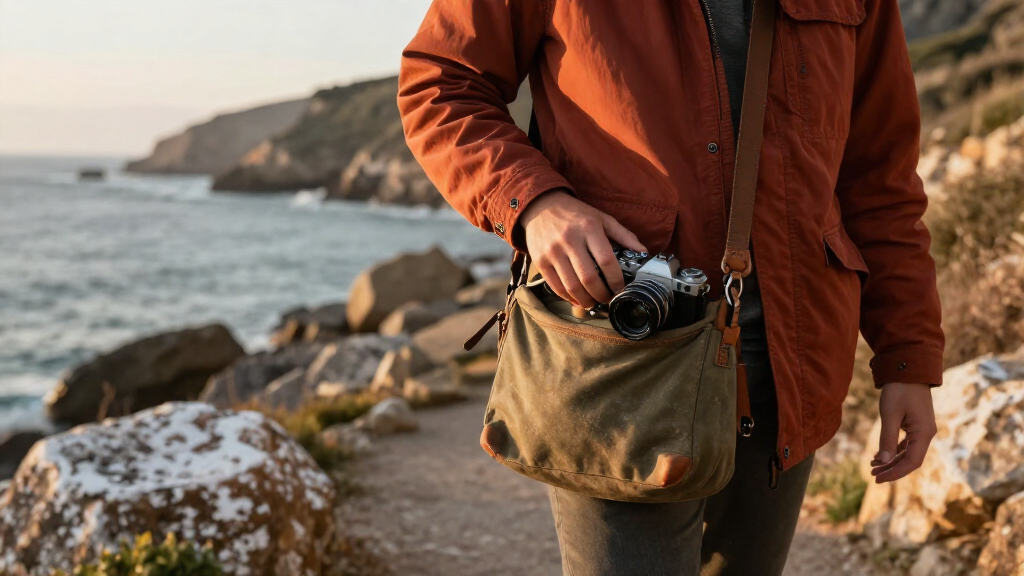
I compared the 13 bags through the decisions that matter on a trip: how they carry gear, how quickly equipment is accessible, and how well their format fits likely travel loads. I also considered stated features such as rain covers, waterproof construction, laptop compartments, tripod holders, convertible or rolling designs, and hard-shell protection. These details affect real use: a tripod holder is useful only if you bring a tripod, while a laptop compartment can make one bag serve more of the journey.
The ranking gives priority to versatility for common travel setups, followed by a clear advantage for a particular need. Backpack options generally rank ahead for heavier loads and longer days; slings and crossbody bags earn their place for compact carry and fast access. Specialized rolling and hardshell formats can suit particular travel routines, but they are less adaptable for everyone. Since capacity, fit, and protection depend on the actual gear and conditions, I treat product claims as features to compare rather than guarantees of performance.
Factors to Consider When Choosing Travel Camera Bags
The right travel camera bag depends less on the number of pockets than on how your kit fits into your trip. I’d decide on your carry load and access habits before choosing a shape, then check whether travel-specific extras solve a real problem for you.
Match the Bag Shape to Your Daily Load
Start by listing the gear you carry on a typical day, including the camera body, lenses, batteries, and any personal items that share the bag. A backpack spreads weight across both shoulders, which can feel better on long walks or when your kit is heavy. A sling or crossbody style can make sense for a light setup and frequent photo stops, but carrying weight on one side may become tiring over time. Avoid choosing a large bag just because it can hold more; unused space can make a compact travel kit harder to organize. Think about the full day’s route, not only the flight to your destination. If your load changes between outings, removable dividers or a flexible interior can matter more than maximum capacity.
Check Access Against Security and Shooting Habits
Fast access is useful when you photograph on the move, but it is not the only kind of access that matters on a trip. Side access can help you retrieve a camera without fully opening a backpack, while a top-loading layout may make it easier to pack a larger kit. At airports and crowded attractions, a closure that opens toward your back may be preferable to an exposed quick-access opening. Consider whether you usually carry the bag on your body while changing lenses or prefer to set it down and open it fully. A design that is quick to reach can also make it easier for someone nearby to reach your equipment, so match convenience with the surroundings where you travel. Test your intended routine by checking how the camera, spare battery, and lens would come out.
Treat Weather Claims as One Layer of Protection
Water-resistant fabric, a waterproof construction claim, and a separate rain cover are not interchangeable forms of protection. A rain cover may help during a sudden shower, but it can be inconvenient to fit while moving and may not protect gear if the bag is left exposed for a long time. Seams, zippers, and openings can matter as much as the fabric label. For trips where rain is likely, look for a design that pairs a weather feature with a layout that keeps gear away from exposed openings. Do not assume that a bag described as waterproof can be submerged or left in heavy weather. If your camera is valuable, keep a dry inner pouch or other backup protection for conditions the bag may not handle.
Count the Travel Extras You Will Actually Use
Laptop sleeves, tripod holders, rolling capability, and convertible straps can make a bag more useful, but each feature should earn its place in your packing plan. A laptop compartment is helpful if you edit or work while traveling; otherwise, it may add bulk without solving a daily need. A tripod holder can free interior space, though it adds external weight and can make the bag less convenient in tight aisles. Rolling camera backpacks may reduce shoulder strain on smooth routes, but stairs, cobblestones, and crowded transit can limit their usefulness. Convertible designs can serve more than one carry style, yet extra hardware and straps may take time to adjust. Prioritize the one or two extras that support your actual itinerary instead of paying in weight and complexity for every possibility.
Check Fit, Not Just the Camera Label
A bag described for DSLR, SLR, or mirrorless cameras does not automatically fit every body and lens combination equally well. Compare the interior layout with the dimensions of your camera and the largest lens you plan to carry, including a lens mounted on the body if that is how you pack. Dividers need to hold equipment apart without forcing it into an awkward position. Leave room for small essentials such as batteries and memory cards, but do not let them shift into the camera’s space. If you expect to carry a laptop or personal items too, check whether those compartments compete with the camera area. A little spare capacity helps when the kit changes, while too much room can leave fragile gear moving around.
Balance Protection Against Weight and Bulk
More structure can help shield equipment, but protection often comes with a larger or less flexible bag. A hardshell design may appeal to travelers who want a firm outer barrier, while a softer backpack can be easier to pack into overhead spaces or carry through a busy day. Padding inside the bag matters too: a rigid exterior does not replace secure dividers that keep lenses from knocking together. Think about how the bag will be stored during transit and whether it must fit under a seat, in a small vehicle, or inside another suitcase. Avoid selecting the most protective-looking option without checking how much it weighs when empty. The best balance is the least cumbersome design that suits your transport conditions and the value of the gear you carry.
Frequently Asked Questions
Should I choose a camera backpack or a sling for a week of travel?
Choose based on the kit you will carry most days, not the longest gear list you could bring. A backpack usually makes more sense for multiple lenses, a laptop, or long walking days because it distributes weight across both shoulders. A sling is better suited to a lighter setup and frequent camera access, especially if you move between short stops. If your trip includes both city walks and heavier shooting days, consider whether you can leave extra equipment at your accommodation and carry only the essentials. Also check how each style sits when worn with a coat or other travel layers.
Is a bag with a rain cover enough protection for a camera in wet weather?
A rain cover can add protection during showers, but it should not be treated as a promise that the whole bag is weatherproof. Water may reach seams, zippers, or openings, and a cover can be awkward to deploy quickly. For regular wet-weather travel, pair the cover with a dry inner pouch for your camera and lenses. Keep electronics away from the bag’s outer walls when possible, and avoid setting the bag in standing water. Check the manufacturer’s care and weather guidance before relying on any protection claim.
Can a travel camera bag also carry my laptop and personal items?
Some bags in this roundup include a laptop compartment, but whether that makes one bag practical depends on the size of your camera kit. A laptop sleeve can simplify airport carry, while personal items may reduce the room available for lenses and accessories. Check the compartment dimensions and how the dividers are arranged rather than assuming all devices or camera setups will fit. If you carry a laptop every day, prioritize a layout that separates it from camera gear and makes both easy to reach. For a compact camera setup, a dedicated camera bag plus a separate personal bag may feel less bulky.
When does a rolling camera backpack make more sense than a regular backpack?
A rolling model can be useful when your route includes smooth airport floors, stations, or hotel corridors and you want to reduce shoulder load. It is less convenient on stairs, rough sidewalks, crowded transit, or routes where you frequently need to lift and carry the bag. Wheels and a handle also take up space and add parts that a standard backpack does not need. Think through the full journey, including the ground between transport stops and your accommodation. If most of your travel is walking or uneven terrain, a conventional backpack is usually the simpler fit.
How much extra room should I leave for a camera bag on a trip?
Leave enough space for the accessories you genuinely expect to use, such as spare batteries, a charger, or a small personal item, but avoid buying around hypothetical future gear. Excess room can let equipment shift, while an overfilled bag can make it harder to reach the camera and may strain closures. Check the fit with your largest lens and any device you intend to carry before setting off. If your equipment changes between trips, adjustable dividers offer more useful flexibility than a much larger fixed layout. Remember that an external tripod holder does not replace space for the rest of your kit.
Conclusion
For a balanced travel setup, I’d start with the K&F CONCEPT Lightweight Camera Backpack with Tripod Holder as the best overall pick, while checking its fit against your exact kit. The best value direction is a straightforward backpack such as the MOSISO Camera Backpack when you want a familiar carry format without prioritizing specialized rolling or hardshell features. For a best premium-style choice based on added protection and a distinctive format, consider the K&F Concept Hardshell Camera Backpack; choose it only if its firmer build suits your travel routine. Beginners carrying a small kit may find the K&F Concept 2-in-1 Camera Sling Bag easier to manage than a large backpack, while travelers with a bigger load should look first at the K&F CONCEPT 30L Camera Backpack. For specific needs, the NEEWER Convertible Rolling Camera Backpack suits smooth, luggage-heavy routes, and the RAINSMORE Waterproof Camera Backpack with Rain Cover is the more relevant choice for travelers prioritizing weather features and laptop carry. The best fit is the one that protects the gear you actually bring without making every day of the trip harder to carry.