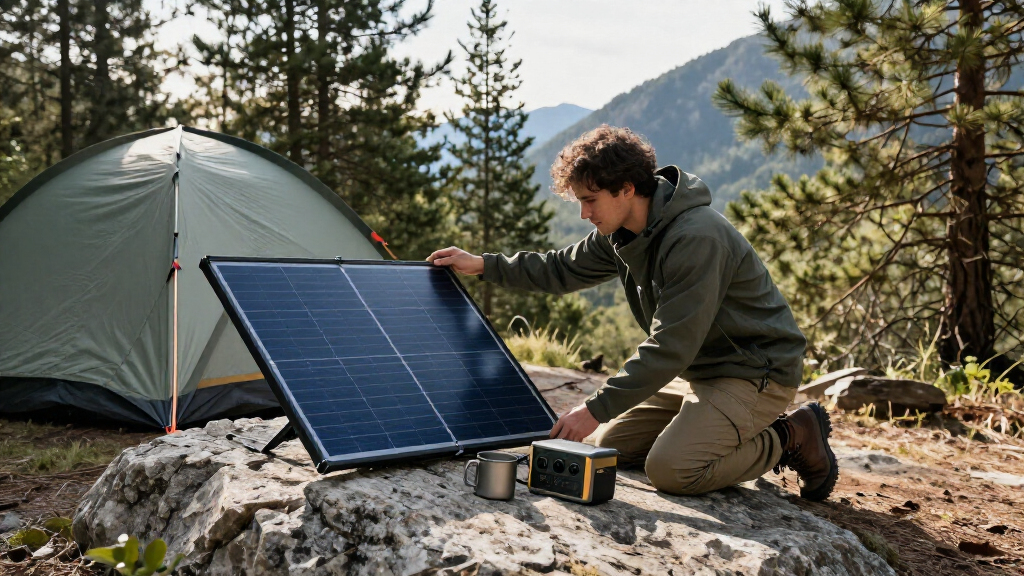
Portable camping solar panels come in two common forms: folding suitcase panels with rigid sections, and flexible solar blankets that fold or roll. They serve the same basic purpose—charging a compatible power station or battery away from the grid—but make different demands on your campsite. The real choice is between a steadier, more self-supporting setup and a lighter panel that takes up less room and fits more easily into a packed vehicle.

Get travel and outdoor gear delivered free with Prime
- Fast, free delivery on millions of items
- Prime Video, Amazon Music and more included
- Member-only deals all year

VTOMAN 40W Foldable Solar Panel Charger with USB-C and USB-A
- ✔ Maximum power: 40 watts
- ✔ USB-C output: PD 30W
- ✔ USB-A output: 1 port

GEYOTO 35W Foldable Solar Charger with USB-C and USB-A
- ✔ Maximum power: 35 W
- ✔ Conversion efficiency: Up to 26%
- ✔ Ports: 1 USB-C, 1 USB-A

CTOLITY 400W Foldable Portable Solar Panel
- ✔ Maximum power: 400 watts
- ✔ Output voltage: 40 volts DC
- ✔ Conversion efficiency: 23.4%
For car campers with space for a dedicated panel, folding models are usually easier to aim at the sun and keep off the ground. Blanket-style panels suit hikers, compact vehicles, and campers who value low packed bulk, provided they can protect the panel and reposition it as the sun moves. Output, included connectors, and usable charging conditions vary by model, so wattage labels alone do not settle the decision.
At a Glance
| Criteria | Folding suitcase solar panels | Flexible solar blankets | Winner |
|---|---|---|---|
| Packed size and weight | Usually heavier and bulkier, with rigid sections and a carry case or handle | Usually folds or rolls into a flatter, lighter package | B |
| Setup and positioning | Often includes a built-in kickstand for angled placement | Must be laid out, hung, or supported; anchoring and repositioning may take extra effort | A |
| Charging performance in camp | Rigid faces can be aimed consistently; rated output still depends on sun, shade, and compatible equipment | Can charge effectively in strong direct sun, but bending, shade, or poor angle can reduce usable output | Depends |
| Durability and care | Rigid surfaces resist creasing but need protection from impact and rough handling | Needs careful handling to avoid abrasion, punctures, and stress at folds or connections | A |
| Surface compatibility | Best on firm, level ground or other stable surfaces | Can adapt to some tent or vehicle surfaces when safely secured and the panel allows it | B |
| Value and ownership cost | Often costs more than a basic blanket at similar rated output, with convenience and support hardware included | Often offers lower packed bulk per dollar, though accessories or replacement needs can change the cost | Depends |
VTOMAN 40W Foldable Solar Panel Charger with USB-C and USB-A
For campers who want a single panel to charge phones and other compatible USB devices, the VTOMAN 40W offers the most balanced mix in this group. It is rated at 40W, five watts above the GEYOTO, and includes a USB-C PD30W output as well as USB-A. That combination gives it a little more headroom on paper while keeping the setup focused on direct device charging rather than a separate power station.At 1.81 pounds, it is still designed to be carried, and its folded dimensions are listed as 11.02 × 11.97 × 0.94 inches. The GEYOTO is lighter and folds to a smaller stated footprint, so that model makes more sense when every bit of pack space counts. VTOMAN’s edge is its higher rated output and IP67 protection, paired with an ETFE coating described as abrasion resistant. Corner holes and included carabiners also give us options for hanging it from gear or arranging it at camp.The tradeoff is that this is not a dependable source of power in shade. The supplied guidance calls for direct sunlight and careful positioning, and output can fall substantially with shade or partial coverage. Its water protection should not be read as permission to submerge the panel; the product notes limit that exposure. Compared with the GEYOTO, the VTOMAN is the more output-oriented compact pick, but buyers who prioritize a smaller packed shape or the included pouch may prefer GEYOTO.
Pros:
- 40W rated output with USB-C PD30W and USB-A
- IP67-rated construction with ETFE laminate coating
- Carabiners and corner mounting holes allow hanging or positioning
- Foldable design weighs 1.81 pounds
Cons:
- Charging can drop substantially in shade or partial coverage
- Requires direct sunlight and careful positioning for best performance
- Not intended for extended submersion
Best for: Campers and hikers who want a carryable panel with both USB-C PD30W and USB-A, and value a higher rated output among the compact USB options.
Not ideal for: Buyers who need reliable charging in cloudy or shaded camps, or who want the smallest stated folded dimensions and lightest listed weight.
Bottom line: Choose the VTOMAN when you want the most capable compact USB panel in this comparison and can position it in direct sun.
“Choose the VTOMAN when you want the most capable compact USB panel in this comparison and can position it in direct sun.”
GEYOTO 35W Foldable Solar Charger with USB-C and USB-A
The GEYOTO 35W is the better fit when a panel needs to take up less room in a pack. Its listed weight is 1.5 pounds, and folded dimensions are 8.29 × 4.76 × 1.57 inches—smaller in footprint than the VTOMAN’s stated folded size. It gives up five watts of rated output, but still includes both USB-C and USB-A, so the main compromise is capacity on paper rather than a narrower choice of device ports.GEYOTO also arrives with a storage pouch and USB-C extension cable, along with two carabiners. Those accessories can make packing and finding a useful panel position easier at camp. Its panel surface is listed as IP68 rated, and built-in overcurrent, overcharging, overvoltage and short-circuit protections add safeguards for connected devices. The stated conversion efficiency reaches 26%, compared with 25% for the VTOMAN, though that figure does not remove the need for direct sun or guarantee a specific charging rate.Compared with the VTOMAN, GEYOTO is the more pack-conscious choice, while VTOMAN offers a higher maximum wattage and USB-C output specifically listed as PD30W. The GEYOTO’s charging output still varies with conditions, and its ports should be kept dry despite the panel surface’s water and dust rating. Pick it for its compact form and supplied accessories; skip it if you want the highest rated output among the smaller panels or need the product details to specify USB-C PD power.
Pros:
- Lightest listed panel at 1.5 pounds
- Smaller stated folded footprint than the VTOMAN
- Includes a storage pouch, USB-C extension cable and carabiners
- IP68-rated panel surface and built-in electrical protections
Cons:
- 35W maximum is lower than the VTOMAN’s 40W rating
- Output varies with sunlight, weather, angle and connected device
- Charging ports should be kept dry
Best for: Campers who prioritize a smaller, lighter folded panel with USB-A and USB-C, included storage and an extension cable.
Not ideal for: Buyers who want the highest maximum wattage in a compact USB panel or need a specifically stated USB-C PD output rating.
Bottom line: Choose the GEYOTO when compact packing and included setup accessories matter more than the highest small-panel wattage.
“Choose the GEYOTO when compact packing and included setup accessories matter more than the highest small-panel wattage.”
CTOLITY 400W Foldable Portable Solar Panel
The CTOLITY 400W occupies a different place in a camping kit from the two USB chargers above. Its stated 400W maximum, 40V DC output and MC4 connectors are aimed at charging a compatible portable power station, rather than plugging phones directly into USB-A and USB-C ports. For a longer base-camp stay, that setup could support a larger stored-power system; it is a poor match for hikers choosing a panel around low carry weight and a small folded profile.Its adjustable kickstands help orient the panel toward the sun without relying on a tree or hanging point, and the ETFE-laminated surface is described as dustproof and resistant to high temperatures. Compatibility is listed for MC4, XT60 and Anderson connections, which may suit a range of station setups. This makes the CTOLITY more adaptable in connection options than either compact USB panel, but the key check is the actual power station’s allowed solar input voltage and connector arrangement.The 40V output may exceed the limits of some power stations, so we would verify the station’s input range before choosing it. The product information also omits both weight and panel dimensions, leaving buyers unable to judge how easily it fits in a vehicle or can be handled at camp. Compared with the VTOMAN and GEYOTO, it offers dramatically higher stated capacity but much less portability information and no listed direct USB outputs. Treat it as a power-station panel whose campsite role depends on confirmed compatibility.
Pros:
- 400W maximum rating for compatible power-station setups
- Adjustable kickstands support sun positioning at camp
- ETFE-laminated surface
- MC4 connectors with XT60 and Anderson compatibility listed
Cons:
- 40V output may not suit some power stations
- Weight and folded dimensions are not provided
- No USB-A or USB-C outputs are listed
Best for: Car campers and base-camp users who already own a portable power station with a compatible solar input and want a high-output panel.
Not ideal for: Backpackers seeking a lightweight direct USB charger, or anyone whose power station input limits and connector needs have not been checked.
Bottom line: Choose the CTOLITY for a compatible power-station setup at a fixed camp, after confirming input limits and making sure its size and weight suit your transport.
“Choose the CTOLITY for a compatible power-station setup at a fixed camp, after confirming input limits and making sure its size and weight suit your transport.”
As an Amazon Associate we earn from qualifying purchases.
Key Differences
The strongest practical difference is how much effort it takes to keep the panel working well at camp. A folding suitcase panel usually opens into a stable, angled position, so it is straightforward to face toward the sun and adjust during the day. That helps when you are charging a power station from a fixed campsite. Its cost is extra weight and a shape that may be awkward to stow alongside tents, coolers, and other gear.
A blanket saves room and can be easier to carry, but flexibility does not mean it can be folded any way or left wherever it lands. A panel that lies partly in shade, sags, or sits at a poor angle can deliver less power than its rating suggests. Blankets also need protection from abrasive ground and sharp objects. The better value depends on whether compact storage or a hassle-free setup matters more: pay extra for a suitcase design when its stand and stable placement will get used often; choose a blanket when its lower bulk solves a real transport problem.
Detailed Comparison
Packed size and weight (Flexible solar blankets wins — moderate)
Flexible blankets generally win on packed size and carry weight. They can fit into narrower spaces than a rigid panel case, which matters in small cars, camper vans, or a backpacking load. The difference is moderate for car campers with generous storage, but potentially major when every compartment is already full. A blanket is not automatically suitable for backpacking, though: check its actual weight, packed dimensions, and whether the rest of the charging system is also portable. Suitcase panels give up space in exchange for a protective, ready-to-carry format.
Setup and positioning (Folding suitcase solar panels wins — moderate)
Folding suitcase panels win for quick, repeatable positioning. Their kickstands, where included, prop the panel at an angle without requiring a separate support, and rigid sections are easier to turn toward direct sun. That is a moderate advantage for camps where you have room to set the panel down and can shift it as the sun moves. Blankets take longer to arrange and may need weights, ties, or a suitable surface to stay put. They are still simple to deploy, but their lightness can make them more susceptible to wind and movement.
Charging performance in camp (moderate difference)
Neither format wins across the board because rated wattage does not guarantee a particular charge rate. The panel needs adequate direct sun, and actual output can fall with clouds, shade, heat, poor positioning, or an incompatible power station input. A suitcase model’s firm face can make it easier to hold a useful angle; a blanket can perform well when it is flat and fully exposed. This is a moderate, model-dependent difference. Compare independent specifications and the power station’s supported input limits, and avoid treating peak wattage as an all-day result.
Durability and care (Folding suitcase solar panels wins — moderate)
Suitcase panels usually have the advantage for routine campsite handling because their rigid surfaces are less prone to abrasion and creasing. They still need protection from drops, impacts, and rough packing, and their hinges or stands can be vulnerable parts. Flexible blankets are easier to pack into tight spaces but require attention to the manufacturer’s fold lines, connector strain, and permitted surfaces. The gap is moderate: a careful user can keep either type in service, while frequent rough handling favors the rigid format. Check the warranty and weather guidance for the particular panel.
Surface compatibility (Flexible solar blankets wins — minor)
Blankets win when camp conditions call for a panel that can lie across a broader area or be secured to a compatible surface. Some can be placed on a vehicle or tent, but users should follow the maker’s instructions and avoid covering ventilation, blocking safe access, or attaching a panel where movement could damage it. Their flexible form is not permission to bend them sharply. Suitcase panels need a stable, level patch of ground or a suitable support, so they are less adaptable when flat ground is scarce. This is a minor-to-moderate advantage, depending on campsite layout.
Value and ownership cost (moderate difference)
Value depends on whether the design removes a recurring inconvenience. A suitcase panel may cost more at a similar rated wattage, but its stand, stable positioning, and more protective form can justify the premium for frequent car camping. A blanket is often the better buy for campers whose storage is limited and who can position it carefully. Differences between brands, connectors, warranties, and included accessories can outweigh the format itself, so compare total kit cost rather than panel price alone. The winner depends on the user’s storage and setup priorities.
Folding suitcase solar panels: Pros and Cons
Pros:
- Built-in stand makes angled placement straightforward
- Rigid sections are easier to position and less exposed to abrasion
- Convenient for a fixed campsite and repeated use with a power station
Cons:
- Heavier and bulkier to store
- Needs a stable area or support for best placement
- Can cost more when rated output is similar
Flexible solar blankets: Pros and Cons
Pros:
- Packs flatter and is often lighter
- Fits more readily into vehicles with limited storage
- Can suit irregular layouts or compatible surfaces
Cons:
- Needs more effort to support, angle, and secure
- Requires care around folds, abrasion, and sharp objects
- Shading or sagging can reduce useful output
Who Should Choose What
Choose Folding suitcase solar panels if:
- You mostly car camp and have room to store a rigid panel.
- You want a stand-supported setup that is easy to aim at the sun.
- You expect frequent use and value simpler handling over compact packing.
Choose Flexible solar blankets if:
- Your vehicle or gear load has limited storage space.
- Lower packed weight and a flatter shape matter more than fast positioning.
- You can lay out, secure, and protect the panel at your campsites.
Skip both if: Skip both if your campsites are usually shaded, you need dependable charging regardless of weather, or you do not have a compatible battery or power station. A solar panel alone is not a guaranteed replacement for stored power.
Value for Money
Pay more for a folding suitcase panel when the stand and stable setup will save time on repeated trips, or when your panel will see frequent handling. That premium buys convenience and a more structured package; it does not guarantee more energy if the models have similar ratings and the sun conditions are poor. For a camper who struggles to fit gear into a small vehicle, the more compact blanket can be better value even if positioning takes longer. Compare connectors, supported voltage and current, warranty terms, and included cables before choosing on price alone.
Final Verdict
For most car campers with adequate storage, choose a folding suitcase panel: it is easier to position, more stable at camp, and better suited to repeated setup and packing. Choose a flexible blanket if packed weight or storage space is the deciding constraint and you are willing to manage its placement and care. The biggest deciding factor is not the panel’s advertised wattage but whether its form works at your campsite. Pay extra for a suitcase model when its stand and sturdier handling solve a problem you face often; otherwise, the blanket is the more sensible compact buy.
Frequently Asked Questions
Are folding panels more powerful than solar blankets?
Not by design alone. Compare the rated output and electrical compatibility of specific models. Either format may produce less than its rated peak when sunlight is weak, the panel is shaded, or its angle is poor.
Can I put a solar blanket on my tent or car?
Only if the panel maker allows that use and you can secure it without blocking ventilation or risking damage. A flexible shape does not mean the panel should be sharply bent or left where it can shift in wind.
Which type is easier to use with a portable power station?
A folding panel is often easier to aim because many models include a stand. With either format, check that its connectors and electrical output match the power station’s solar input limits.
Is a solar panel enough to power a campsite overnight?
Usually the panel charges a battery or power station during daylight; that stored energy runs devices later. Whether it covers your needs depends on your equipment, daily energy use, sun exposure, and battery capacity.
Fall Picks

DJI Osmo Action 5 Pro Essential Combo Waterproof 4K Action Camera
As an affiliate, we earn on qualifying purchases.