
Ultra-wideband (UWB) technology is quietly making its way into your phone, offering precise location capabilities that let devices interact more accurately and securely. It uses broad radio spectra to measure distances and track nearby objects within centimeters, enabling features like secure access and smart automation. While UWB improves convenience and security, it also raises privacy concerns because it can track your movements and nearby devices in detail. Stay informed to discover how this technology impacts your privacy and how to protect it.
Key Takeaways
- UWB technology enables smartphones to determine their location with centimeter-level accuracy.
- It uses broad radio spectra and short pulses for precise device positioning.
- UWB enhances features like secure device unlocking and asset tracking in phones.
- Privacy concerns include potential user movement and nearby device tracking.
- Manufacturers implement privacy controls, encryption, and regulations to protect user data.

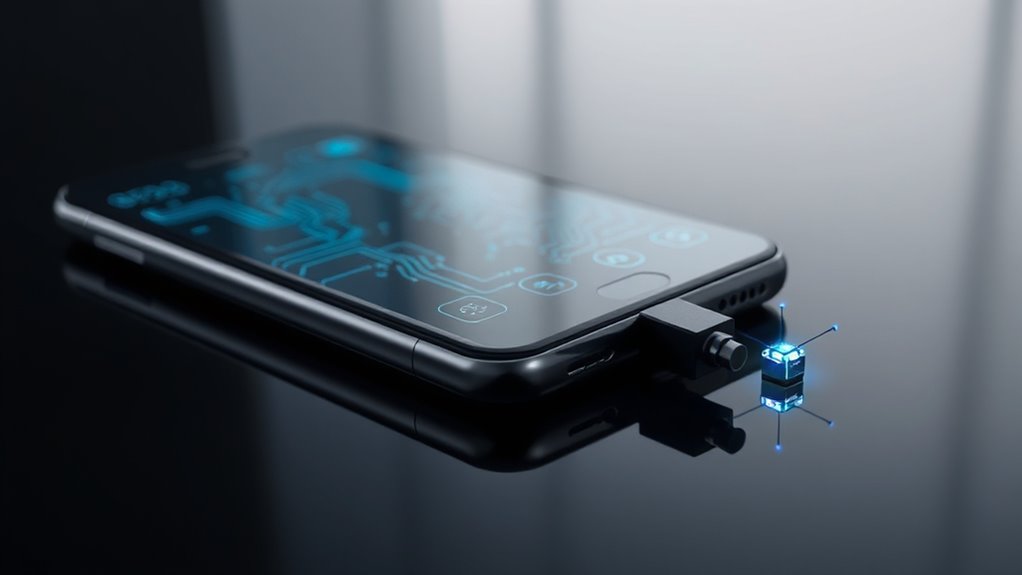
Have you ever wondered how devices can locate each other with such remarkable accuracy? Ultra-Wideband (UWB) technology makes this possible by using a broad spectrum of radio frequencies to measure distances with incredible precision. Unlike traditional Bluetooth or Wi-Fi, UWB transmits short pulses across a wide frequency range, allowing it to calculate the exact position of nearby objects or devices. This level of device accuracy is what makes UWB so appealing for various applications, from unlocking your car to tracking assets in warehouses. The technology can determine location within a few centimeters, offering a level of detail that was previously unattainable with older methods.
Ultra-Wideband (UWB) technology uses broad radio spectra for precise device location within centimeters.
As UWB becomes more common in smartphones and other personal devices, privacy concerns inevitably follow. Since UWB can precisely track your movements and the location of other devices around you, it raises questions about how this data is collected, stored, and used. You might worry that such detailed tracking could be exploited for unwanted surveillance or targeted advertising without your consent. Manufacturers and developers are working to address these concerns by implementing strict privacy controls, such as user permissions and data encryption. However, it’s essential to stay informed about how your device handles this sensitive information to protect yourself from potential misuse.
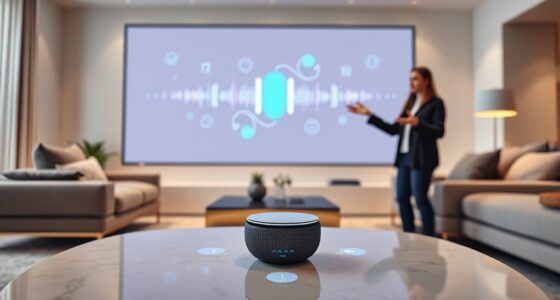
The benefits of UWB’s device accuracy are clear. For example, in a smart home environment, UWB can help your devices understand each other’s positions, enabling seamless automation—like turning on lights when you enter a room or unlocking doors as you approach. In retail or logistics, UWB helps track inventory with high precision, reducing errors and improving efficiency. Yet, the same precision that makes these functions possible also makes privacy a critical issue. With such detailed location data, there’s always a risk of it being accessed by unauthorized parties, whether through hacking or data leaks.
Despite these concerns, efforts are underway to guarantee privacy is maintained. Many devices now include settings to limit tracking or disable UWB when not needed. As the technology evolves, regulations and standards will likely tighten to prevent misuse. Still, it’s wise to be cautious and understand how your device’s UWB features operate. Being aware of device accuracy capabilities helps you appreciate the convenience it offers, while understanding privacy concerns reminds you to stay vigilant about your personal information. Ultimately, UWB’s ability to deliver precise location data opens exciting possibilities, but balancing innovation with privacy protection remains essential.
Frequently Asked Questions
How Does UWB Compare to Bluetooth and Wi-Fi in Accuracy?
You want to know how UWB compares to Bluetooth and Wi-Fi in accuracy. UWB offers much better accuracy because it uses wide frequency ranges for precise distance measurements, often within centimeters. Bluetooth and Wi-Fi rely on signal strength and network data, which are less precise. The technological differences make UWB ideal for pinpointing locations, while Bluetooth and Wi-Fi serve better for general connectivity and range.
Will UWB Drain My Phone’S Battery Faster?
Some might think UWB drains your phone’s battery faster, but it’s actually quite power-efficient. You investigate the theory and find that UWB uses minimal battery consumption because it’s designed for short-range, precise communication. Compared to Wi-Fi or Bluetooth, UWB’s power efficiency helps preserve your device’s battery life. So, using UWB for location features shouldn’t substantially impact your phone’s overall battery consumption, making it a smart tech choice.
Is UWB Secure for Sensitive Location Data?
You might wonder if UWB is secure for your sensitive location data. While privacy concerns exist, UWB uses data encryption to protect your information from unauthorized access. Manufacturers implement security measures, but always stay cautious and review app permissions. Trustworthy hardware and software updates help maintain security. Overall, UWB can be safe if proper encryption and privacy protections are in place, reducing risks associated with sensitive location data.
Which Smartphones Currently Support UWB Technology?
You’ll find that many recent smartphones support UWB technology through specific UWB chipsets, which enable precise location features. Popular models from Apple, such as the iPhone 11 and newer, include UWB chipsets, making them compatible with UWB-based accessories and features. Samsung’s Galaxy series, like the Galaxy Note 20 Ultra and newer, also support UWB. Always check smartphone compatibility to guarantee your device has the necessary UWB chipsets for peak performance.
Can UWB Be Used for Indoor Navigation?
You can definitely use UWB for indoor navigation, as its ultra wideband applications include precise positioning where GPS often fails indoors. Unlike indoor GPS, UWB offers higher accuracy and security, making it ideal for navigation within buildings. It works with short-range signals to detect your exact location, providing a seamless experience. UWB vs. indoor GPS highlights UWB’s superiority in accuracy, making it a game-changer for indoor mapping and navigation.
Conclusion
As UWB quietly weaves itself into your phone, it’s like a secret handshake revealing a world of precision. Imagine your device as a trusted guide, pinpointing your exact location with laser-like accuracy, all while you go about your day. Soon, this invisible tech will enhance your interactions—unlocking doors, finding your keys, or guiding you effortlessly through busy streets. It’s the unseen magic transforming your phone into a smarter, more connected companion.